

Listen to this episode on Spotify or Apple Podcasts
He asks me to wait.
“Hang on, hang on,” Pete Hunt says, right before we start recording. “Let me spin down these agents I have going on so I don’t mess up the recording quality.”
I stop and register what he just said. Not put my phone on silent. Not close some tabs. Spin down his agents. The CEO of Dagster Labs — a venture-backed company building AI-powered revenue forecasting — has to actively wind down the AI workflows running in the background just to free up enough bandwidth for a podcast. In March 2026, this is what preparing for a meeting looks like.
I mention it when we start. He doesn’t elaborate. He doesn’t need to.
Pete Hunt is not someone who traffics in hype. He comes from an engineering background — he was an early member of the React.js team at Facebook, one of the most consequential open-source projects in the history of the web. He’s been in the startup world long enough that he doesn’t need to perform enthusiasm. What he does instead is tell very specific stories about very specific moments where something stopped making sense.
The thing that stopped making sense — for a long time — was Salesforce.
I come to this conversation with history. I’m a product designer who spent years inside the machine, in organizations that had Salesforce and couldn’t make it work. I’d watched rev ops teams fail not because the concept was wrong but because the implementation always seemed to require someone saying “five to six digits of implementation spend” before you could even get the thing to do what you needed. There’s a multi-billion dollar consulting industry built entirely around one software product. That’s not a feature. That’s a confession.
Pete understands this. The rev ops function — the people responsible for clean forecasts, accurate data, and the infrastructure to actually sell — matters more than most startups realize, he says. Pre-sales engineering, too. Most of the startup playbooks he’s seen skip both. They tell you to hire a great head of sales, hire reps at the right velocity. What they leave out is the foundation underneath.
“You know what I would always get back?” he says, describing his own forecast meetings at Dagster. “This is what it’s gonna be because Salesforce says so. Then it would always be wrong.”
He says it without heat. Not frustrated, just describing a pattern he’d seen enough times that it stopped surprising him. The pretty dashboards would say one thing. The salespeople on the ground would say something different. Every deal was a snowflake. You couldn’t get an aggregate view. And when you told the team to create pipeline, they would put pipeline into the CRM — because that’s what you asked for. Not because the deals were actually going to close.
“If you tell your sales team to create a pipeline,” he says, “they get happy ears and they put stuff in the pipeline and they defend it even when maybe it shouldn’t be defended.”
This is the data problem that eventually built Compass. And it started, improbably, on a plane.
Pete was flying to Snowflake Summit. I keep returning to this detail — the particular absurdity of a CEO of a data company going to a major data conference while being completely unable to trust his own company’s pipeline data. He’d gotten fed up. Not with rev ops as a concept, but with what it cost to get to the truth. “We’re not a huge company,” he says, “but it was going through two or three layers of people to get to the truth. It was kind of ridiculous.”
So on the plane, with nowhere to be, he did something with the kind of casual ambition that only makes sense in retrospect. He exported his opportunities from Salesforce as a CSV. He opened Cursor. He had the DuckDB command-line tool, which lets you run SQL queries against a flat file.
“I said, hey Cursor, I’ve got this CSV of my pipeline. Can you forecast my next quarter for me?”
What happened next is the reason we’re talking.
“It did a way better job than any other tool that we had.”
He was able to ask follow-up questions in plain English: why is this opportunity low likelihood? And Cursor would reason through it — this deal hasn’t had activity in thirty days, deals that sit in eval too long tend to be zeros, this one’s probably not going to make it to negotiation. Something shifts in the way Pete describes this moment. It reads less like excitement and more like recognition — the feeling of having looked for something in one place for years and finally finding it somewhere else entirely.
“The models had gotten really good,” he says. “Sonnet 3.5 at this point. And I was like, man, this is incredible. I want this now to run my business.”
He had to build it himself first. A crude command-line tool that produced bar charts as files on disk. Primitive. Dagster ran its business on that crappy system for a while. Then his data analyst looked at what Pete had cobbled together and said: you should make this a Slack bot.
“We gave it to everybody at the company,” Pete says. “It caught fire like crazy. Everybody started using it every week, or every day even.”
Then investors. Then customers. Then a product.
The arc from “guy with a CSV on a plane” to “CEO building an enterprise AI product” is shorter than it sounds when Pete tells it. What he’d stumbled into wasn’t a technical breakthrough — Cursor was already there, the model was already capable. What he’d found was a question that nobody’s existing tooling could answer. Not in real time. Not conversationally. Not without going through layers of intermediaries who were, in some sense, incentivized to defend the data they’d already entered.
I’d spent years in product. I knew exactly what he was describing. When I first found out what rev ops was actually supposed to do — forecast revenue, give you a clear view of pipeline, tell you if you’re qualifying the right leads — I wanted it. And every implementation I’d seen failed to deliver. Not because the people running it were incompetent. Because the infrastructure they were working with was designed for a world where getting to the truth required going through someone.
“AI isn’t taking jobs away,” I tell Pete at one point. “It’s taking away excuses.”
“Hmm.” He sits with it. “Yeah. Like, my first question when somebody has a question about the codebase is, did you ask AI about that?”
This is not what change management looks like in a workshop. Pete is explicit that mandates didn’t work. He tried nudging, encouraging, expensing tools. Some people got on board, some pushed back, some tried it and walked away. The people who were most resistant — who genuinely disagreed with the direction — he sat them down individually.
“Listen,” he told them. “This is an agree-to-disagree situation at this point. I respect you as a professional and you’re good at your job. But this is a place where we disagree.”
Some of those people became enthusiastic users of the AI products they’d resisted. Others went somewhere less AI-oriented. He says it without judgment. The thing that actually moved the organization wasn’t the memo or the mandate or the lunch-and-learn. It was the staff engineer who got religion on it and started unblocking big initiatives, faster than anyone expected. The domino effect — when someone everyone looks up to quietly starts doing things differently — that’s harder to ignore than any policy.
“That very opinionated staff engineer that everybody looks up to gets religion on it,” Pete says, “and then they start to really drive the authentic bottoms-up change throughout the organization.”
What Dagster is building now is, in some ways, the formalization of Pete’s plane experiment — with better infrastructure and a deliberate theory of behavior underneath it. The reason dashboards fail isn’t data quality. It’s access friction.
“If you put the M&Ms on the kitchen counter,” he says, “you’re going to eat the M&Ms. And if you make it really hard to access data, you’re never gonna look at the data. It doesn’t matter if your boss says you should be data driven.”
Compass is built around this idea. Make data fast and easy and fun. Pete describes the product’s personality — without apology — as what you’d get if you “hired a sassy Gen Z data scientist, locked them in a basement, and made them analyze data all day.” Something shifts in his voice when he describes it, like he’s relieved someone finally asked. The product drops memes when your pipeline is off track. It pushes insights before your sales calls. It reads like a personality, not a tool.
“When it’s fun and when it’s easy to use,” he says, “way more people use it and way more people ask questions of it every day.”
He frames the larger goal through the OODA loop — observe, orient, decide, act — the decision-making framework developed by Air Force strategist John Boyd and since borrowed by everyone from venture capitalists to sports coaches. The insight is simple: the faster you cycle through observation and action, the more likely you are to win. Compass is an attempt to speed up the observation step for go-to-market teams. Not just for the data analyst or the rev ops person. For every stakeholder who needs to know what’s actually happening in the pipeline.
“If you do more of those loops than your competitors over a given timeframe,” Pete says, “you’re gonna win.”
It’s a different frame than what most people use for revenue operations software. The standard frame is tooling: which CRM, which dashboards, which reports. Pete’s frame is metabolic. How fast is your organization processing reality?
I leave this conversation thinking about the plane. Not because it’s a good origin story — though it is — but because of what it required Pete to already believe. To export your pipeline as a CSV on a flight and ask an AI to forecast your quarter, you have to be willing to accept that what you’ve paid for isn’t working. You have to have run out of patience with the thing that was supposed to solve the problem.
“Number one,” Pete says, describing what the experiment taught him about AI, “it became accurate enough to be useful. And number two, I began to be trained to kind of expect some level of inaccuracy, and that was actually fine.”
That’s the real shift. Not that the model was perfect. That Pete had recalibrated what he expected — and what he was willing to accept — and found that the new standard was better than the old one. Humans and AI systems meeting in the middle. Each one adjusting to what the other can do.
The forecasts are still not perfect. They never were. But at least now they can tell you why.
About Pete Hunt
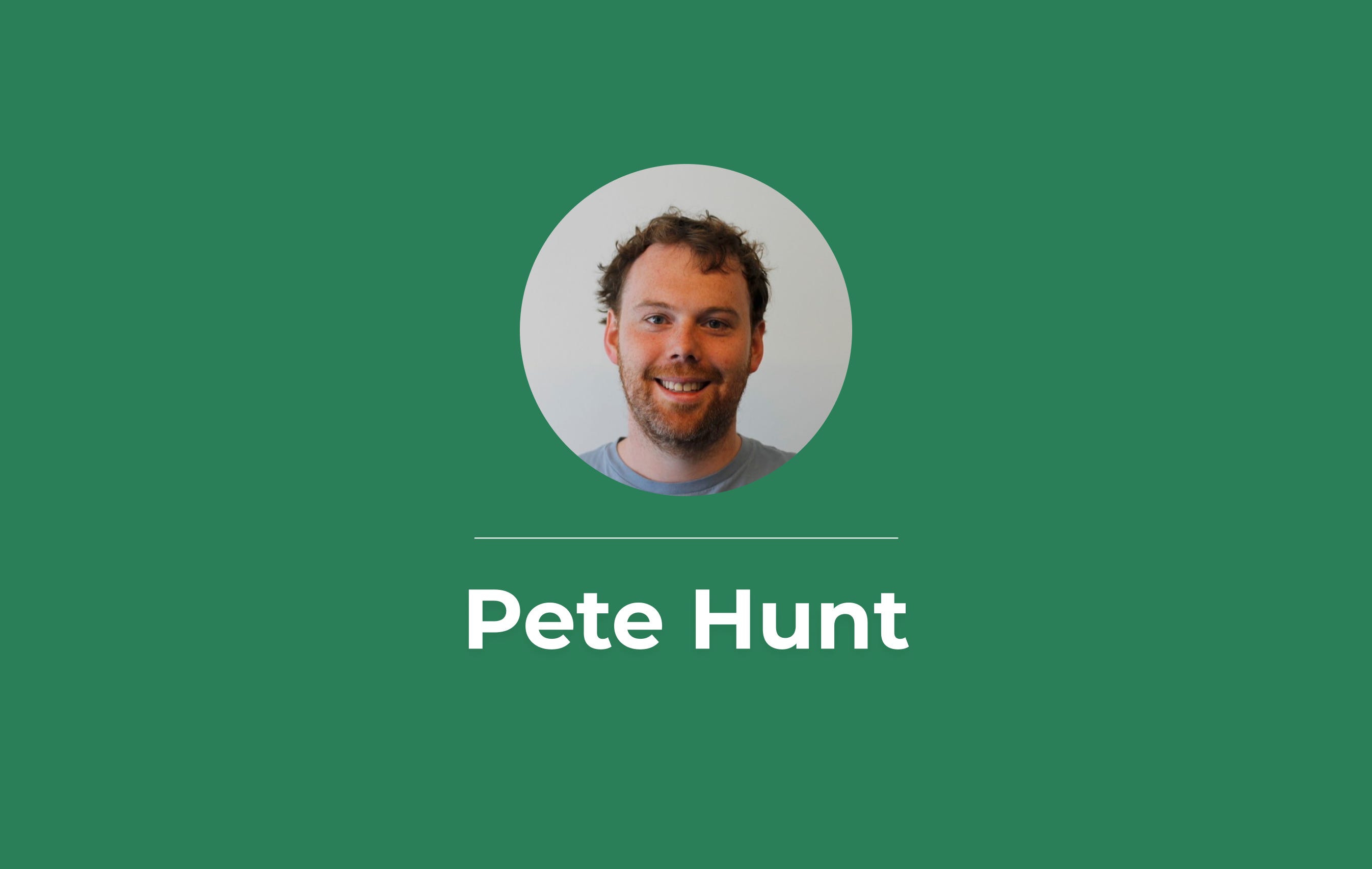
Pete Hunt is the Chief Executive Officer at Dagster Labs, the company behind the open‑source data orchestration platform Dagster and its commercial Dagster Cloud offering. Rising to prominence in the early 2010s, he became known as one of the early leaders of the React.js project inside Facebook and as a key engineering voice at Instagram during its hyper‑growth period. Today he is widely regarded as an influential figure at the intersection of data platforms, infrastructure, and developer experience, helping teams modernize how they build and operate data‑intensive systems.
Previously, as Head of Engineering and then CEO at Dagster Labs, Hunt helped guide the organization from its early identity as Elementl, founded in 2019, to a commercial data orchestration leader with the launch of Dagster Cloud and the introduction of Software‑Defined Assets in 2021. After joining the company in early 2022, he assumed the CEO role in November 2022 and has since focused on turning Dagster’s open‑source traction into a scalable business with a repeatable go‑to‑market motion. Under his leadership, Dagster Labs has grown into a well‑funded, small but highly specialized team shipping infrastructure that supports thousands of data assets across modern data stacks.
His career highlights include a formative stretch at Facebook beginning around 2011, where he was a founding member of the React.js team and helped drive its transformation from an internal experiment into one of the most widely adopted front‑end frameworks in the world. After the Instagram acquisition in 2012, Hunt became the first Facebook engineer embedded into Instagram, led the instagram.com web team, and built Instagram’s business analytics products as the company scaled to hundreds of millions of users. In 2014 he co‑founded abuse‑fighting startup Smyte, serving as CEO for roughly four years until its acquisition by Twitter in 2018, where he then worked on Trust & Safety and infrastructure during a period when the platform handled hundreds of millions of daily active users. Across these roles he has consistently operated at the point where new infrastructure—React, Instagram’s web stack, Smyte’s anti‑abuse systems, and now Dagster—becomes robust enough to support global‑scale products.
Outside his operating roles, Hunt has built a durable reputation as a conference speaker and educator, giving talks at events such as OSCON 2014 on how instagram.com works and sharing practical lessons on React, data platforms, and engineering leadership. Through long‑form interviews and podcasts, he documents the transition from individual engineer to founder and CEO, making him a widely referenced voice for engineers moving into executive roles.
Hey—Thanks for reading this. I mean that. There's a lot of content out there competing for your attention, and you spent some of it here. I hope it was worth it. Even better, I hope it prompted you to think about something differently enough that you'd share it with someone who'd get something out of it too.
I started this podcast because tactics never stuck with me. What stuck were stories — business biographies, autobiographies, the decisions people made and why they made them. The principle only clicks once you know the story behind it.
So I built the thing I wanted to read. Every week I have two conversations with people who build in technology and product. Then I write the essay I wish I could find — one that puts you inside the conversation, through my eyes. What caught me off guard. What I kept thinking about after we hung up. Where the principle actually lives once you strip away the jargon.
I make this for myself first. If you read the way I do, you’ll want it too.
PS — If you want to pitch coming on the show, or you know someone I should talk to, shoot me an email at caden@hey.com with "January752" in the subject line so it gets past my filters. I'm not optimizing for famous guests. I'm optimizing for interesting conversations, even from people who aren't LinkedIn influencers.


