

Listen to this episode on Spotify or Apple Podcasts
Karl Simon tells me he walked into a Barnes and Noble, picked up Ralph Kimball’s Data Warehouse Toolkit, and taught himself database management overnight so Oracle could ship orders same-day. That was three decades ago. The man has been solving logistics problems with data architecture since before most of us knew what a data warehouse was.
I bring up an old maxim I’ve been turning over: amateurs worry about tactics, professionals worry about logistics. It’s been pivotal in how I think about senior IC work. Second-time founders obsess over distribution for the same reason. When the army doesn’t have food, you get Napoleon’s Russia campaign. And what Karl did at Oracle — going to a bookstore to close a knowledge gap on his own — that’s the kind of high agency I find rare and magnetic.
“The cost of agency is going down,” I say at one point, riffing on an insight from a prior episode. Karl stops me.
“Can I actually quote that?” he says. “’The cost of agency is going down.’ Love that quote because it should, first of all, it’s true. And then secondly, that should de-escalate any level of fear of AI taking over.”
Something clicks for me in the way he says it. Not as a platitude, but as a structural observation. I start pulling the thread of history out loud — feudalism hoarded protection, the Industrial Revolution broke that pattern and capital became the thing to hoard, then technology reduced the cost of making things over the last few decades, and now what they’ve been hoarding is agency. The ability to work the way you want. To think strategically. To have autonomy over your process.
Karl nods and extends it: “The opportunity for increased agency, being able to actually perform within more of an unbounded way, as long as you again, roll up and align to company goals... you’ve never had more freedom than you’ve had now to show who you are, how you like to think, and what you represent to the company.”
This is the core tension of the episode for me. I’ve watched people I respect — smart, capable people — get labeled as “low agency” at work. But they’re not low agency. They have fascinating hobbies they’re trying to master. They just couldn’t access that mode at work because the system wasn’t designed to let them. I had to dedicate years of extra work outside of my day job to speed the learning curve and rise high enough that I could work the way I wanted to work. And I don’t recommend that path to anyone. It’s a path of zero hobbies and fanaticism to craft. It’s just what I chose to do.
Karl’s work at Subatomic is interesting because it attacks the problem architecturally. When I ask him to explain knowledge graphs for non-technical listeners, he uses my podcast as the example. Caden runs a podcast. The podcast is named Way of Product. The podcast focuses on timeless considerations in product management. You keep going down the tree of relationships — categories, subcategories, themes — and you get an ontology. A map of how things relate.
I push the idea further: “If you show me someone’s data graph, you’re showing me the business logic. You’re showing me the strategy of the business.” Because you don’t want your graph to look like your competitor’s. That’s where the edge lives — in the architecture itself.
Karl agrees and then takes it further. It’s not just about representing what is. It’s about encoding how you think. Graph RAG — retrieval augmented generation built on a knowledge graph — lets you embed reasoning patterns into the system. A wealth advisor’s philosophy about when to prefer merger arbitrage over bonds given certain macro conditions, for example. That reasoning gets pulled at runtime, checked against ground truth, and then evaluated over time so the system can self-improve.
“Having a very good data graph is no different than having a well-written SOP document for a human,” I tell him. If your mental model of how operations should work is vague, humans churn. Same with AI. Precision leads to capability.
What surprised me most was how personal the unlock feels. I tell Karl about my own workflow — I have a prompt improver that I dictate to in natural language, and through memory, the AI has learned that I usually look back five days for certain records. I said it offhand once. Now the system self-filters its plans to that window without being told. It’s learning like an intern would.
“The unlock is that you get to do things the way you best work,” Karl says. “The way you optimally come to conclusions, decisions or outputs that you need to deliver.”
And that’s what I keep coming back to. The weird personal outcome of all this? I read physical books again. Actual paper. Because I don’t feel guilty about it anymore — the busywork that used to fill my time has been abstracted away. The data collection, synthesis, communication memos that used to be the entire job of everyone below middle management — AI handles that now. And it means everyone, not just executives, can operate strategically.
Agency used to be expensive. You had to earn it through years of proving yourself, navigating politics, building leverage. Now the ceiling is broken. The question isn’t whether AI will take your job. The question is whether you’ll use it to finally do the work you always wanted to do.
Listen to this episode on Spotify or Apple Podcasts
About my guest & how to find them online
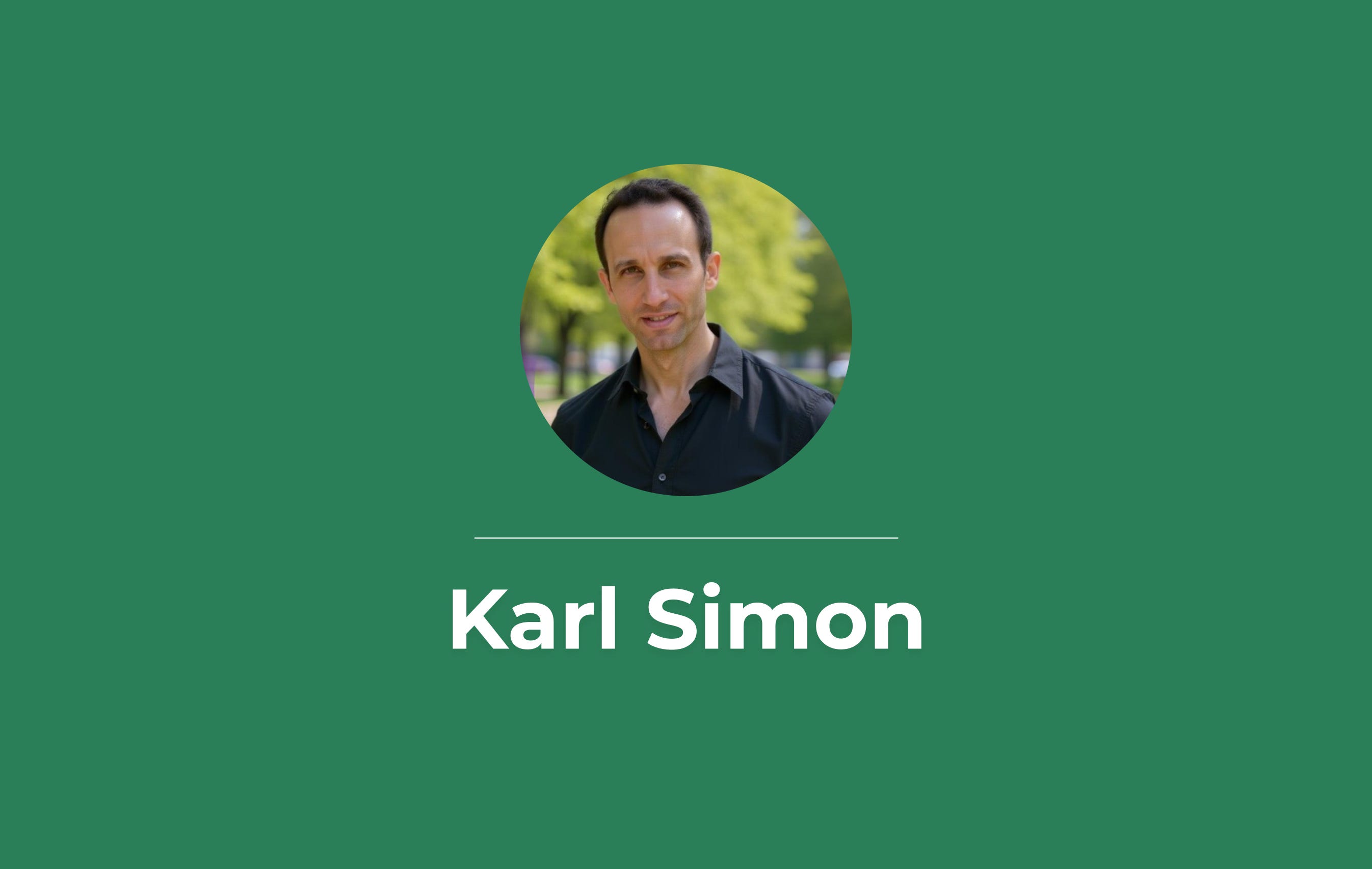
Karl Simon is the Co-Founder and CTO of Subatomic AI, an enterprise AI Co-Worker Agent platform that deploys customizable agents adapted to client workflows, philosophies, and reasoning patterns. Rising to prominence in the 2010s as a data and engineering leader across retail, healthcare, and life sciences, Simon became known for building globally distributed data organizations and modernizing legacy platforms to support AI and machine learning at scale. Subatomic, co-founded with CEO Sam Sova and backed by a $7 million seed round in October 2025 led by Vantage Financial, focuses on high-stakes verticals including wealth management, legal, and manufacturing.
Previously, as a senior technology leader at Hudson’s Bay Company — the retail conglomerate that housed Saks Fifth Avenue, Lord & Taylor, Gilt.com, and other brands now consolidated under Saks Global — Simon led all engineering, business intelligence, and AI/ML functions across the company. Before that, he served in data engineering and analytics leadership roles at Komodo Health, Accenture, and Genentech, building AI-enabled decisioning platforms and modernizing source-to-target data pipelines across healthcare and life sciences.
Earlier in his career, Simon joined Oracle in manufacturing distribution, where he self-taught data warehousing from Ralph Kimball’s Data Warehouse Toolkit before applying those techniques to improve same-day order fulfillment insights. That formative experience established his approach to grounding AI systems in well-architected data foundations — a philosophy he has carried through more than three decades of digital transformations spanning mobile, big data, and generative AI.
Hey,
Thanks for reading this. I mean that. There's a lot of content out there competing for your attention, and you spent some of it here. I hope it was worth it. Even better, I hope it prompted you to think about something differently enough that you'd share it with someone who'd get something out of it too.
I started this podcast because tactics never stuck with me. What stuck were stories — business biographies, autobiographies, the decisions people made and why they made them. The principle only clicks once you know the story behind it.
So I built the thing I wanted to read. Every week I have two conversations with people who build in technology and product. Then I write the essay I wish I could find — one that puts you inside the conversation, through my eyes. What caught me off guard. What I kept thinking about after we hung up. Where the principle actually lives once you strip away the jargon.
I make this for myself first. If you read the way I do, you’ll want it too.
PS — If you want to collaborate on the show, or you know someone I should talk to, shoot me an email at caden@hey.com with "January752" in the subject line so it gets past my filters. I'm not optimizing for famous guests. I'm optimizing for interesting conversations, even from people who aren't LinkedIn influencers.


