

Listen to this episode on Spotify or Apple Podcasts
I ask Adam a hypothetical, the kind that almost always gets a hedged answer.
Could he have started Pentane — his profitability operating system, three years in, used by e-commerce founders to figure out whether they’re actually making money — if he hadn’t spent the decade before it running BottleKeeper?
“Absolutely not,” Adam says. “No way.”
No throat-clearing. No “well, probably not, but you could argue.” Just the flat refusal. He says it the way you say something you’ve already considered from every angle and stopped re-litigating. The certainty is the kind that only comes from having tried to imagine the alternative and failed.
Pentane is a profitability OS. The phrase sounds modular and abstract, the kind of thing pitched at a SaaS demo day. But the actual product is something simpler than that: it answers the question most e-commerce operators don’t have a clean way to ask, which is whether the next ad dollar makes them money or loses them money, and why.
Adam built BottleKeeper from 2013 onward — a beverage insulator brand that grew from zero to $60 million in total sales and exited via private equity. He lives in Montana, does hard physical things in the woods because he believes adversity is a muscle you have to train deliberately. He’s been on Shark Tank. He has the operator’s posture of someone whose CV is mostly stories about the hours nobody filmed.
The Pentane thesis is that he could not have built Pentane any other way. Not on a whiteboard. Not from market research. Not from talking to other operators. Only from being the operator who’d run out of answers.
“I was CEO of a company with no employees doing $8 million a year,” he tells me, and the line lands without performance. He isn’t bragging. He’s establishing the conditions. “I literally did everything — all the customer service, all the paid ads, built the campaigns, spent millions in ad budget, did the creative, built the website.”
He qualifies it a beat later. “My cousin and I — he was my partner, he did most of the finance and shipping and fulfillment and things like that.”
Two people. Eight million in revenue. The math of that is the whole story.
The Facebook video ads moment came in August 2014. Adam shot a video of the product in action — the kind of thing that, in retrospect, was the inflection. Revenue went from two thousand a month to forty to sixty to eighty to a hundred and fifty.
“We sold out of product and we just chased that for years,” he says.
In those first three years he didn’t need systems. He couldn’t spend the ad money fast enough. The growth was hosing him down. WordPress, then WooCommerce, eventually Shopify. The systems were unnecessary because the problem was unaddressed.
Then 2016, 2017. CPMs going up. Returns coming down. He saw it the way anyone in paid media that window saw it — the loose-attribution years closing, the spreadsheets getting more honest. He was about to hire his first team member. The slack in the business was disappearing.
“I needed to get a much better handle on the decisions I was making around what to spend, how much to spend, where to spend it, how it needed to return in order for us to be profitable,” he says. “’Cause we had to be profitable. And what happened if we ran a sale, or what happened if I increased prices — which is something we did really aggressively. And then as we hired people, how was I going to ensure that our customer acquisition and revenue was built in a way that could pay for those people, so we weren’t just spending into a hole.”
The math didn’t exist anywhere he could find. So he wrote it. In spreadsheets, for himself, as the CEO who had nowhere else to send the question. He was answering questions, he tells me, that he “couldn’t find answers to anywhere else.”
That’s the part most product-origin stories skip. Adam didn’t start by trying to solve a market. He was trying to not run out of money. The spreadsheets weren’t a product. They were a way of staying alive.
The company sold. A year after the acquisition, he got bored.
“I went to companies I had invested in and asked if I could help,” he says. “Realized they had the same problems. They just didn’t have the system to help solve the problem and answer the question. So I just rebuilt what I had already done in them and it completely changed them.”
That’s the moment the survival math became a product. Not because he had a vision. Because three founders he respected were drowning in the same way he had been, and his hand-built thing pulled them out.
“I built the thing because I had to,” he says when I ask him to describe Pentane’s actual genesis. “Because I had companies that were using it and it dramatically impacted their net profit outcomes.”
The genesis is causal, not creative. He didn’t have an idea. He had a discovery.
He keeps coming back to the way finance and marketing speak different languages — that gap is where companies bleed. Pentane lives in the gap. The math is provided by the system; an AI layer applies Adam’s mental framework to the operator’s specific situation. The equations don’t come from the model. The model isn’t allowed to invent them.
“It can do math really well,” he says of AI, “but it’s freaking awful at creating the equations if they’re not entirely logical.”
This is the technical detail that doubles as a worldview. You don’t let the AI decide what to measure. You let the operator who’s lived the problem decide what to measure, and you let the AI execute against that decision faster than the operator could.
Three years in, Adam is at a different point on the curve. He’s rebuilt the Pentane product three times by now. V1 was the dev shop he handed fifty thousand dollars to, with a spreadsheet and an instruction: make this. It took the money and produced functional software that made perfect sense to Adam and no sense to anyone else.
V2 took nine months. Better, still not great.
V3, the one his customers are testing now, he built in a weekend.
“I just recreated our entire platform in three days,” he says, and his dev team’s response was “holy hell, this is incredible. They’re fully in support of it.”
He showed it to a customer the day before our recording. The customer’s response, verbatim: “Holy shit, this is so much better. Can I have this now?”
I tell him about the equivalent moment in my own work — pulling a client’s data into a prototype, sending them the link, watching them realize they’re finally looking at the thing they’ve been describing for months. The feedback loop collapses from quarters to minutes. The fidelity arrives at conversational pace.
But Adam frames the speed in a way I don’t want to lose. The reason he can rebuild Pentane in a weekend isn’t the AI. It’s the two and a half years of trying to build it and getting it wrong.
“I don’t know what to tell the AI to do unless I have the last two and a half years of breaking it and screwing it up,” he says.
The acceleration is real. The acceleration is downstream of the operational pain that came first. AI didn’t compress his timeline. His timeline compressed his AI.
Near the end of the conversation we’re talking about something else — DoorDash, whether a logistics platform could vertically integrate into restaurant management software now that the tooling exists — when Adam reaches for an image that I think is the real thesis of his career, and the real reason Pentane exists at all.
“DoorDash probably can spin up that vertical,” he says, “but only because they’ve spent the last 15 years with the people at the top of that company chewing on glass. Almost failing over and over and over to get the product to where it is today.”
Chewing on glass. The verb is grotesque on purpose. It’s the part of the operator’s experience that doesn’t make it into the case study, what gets sanded off when the story gets retold for the press release. And it is, in Adam’s worldview, the only reliable source of product taste.
There is no shortcut to it. There is no AI that can simulate it. There is no consultant who can bottle it.
You eat the glass, or you don’t get the taste.
I think about what that means for everyone now standing at the edge of vibe coding with a copy of Cursor open, building the thing they always wished they had. The tools are there. The math is cheap. The aperture is enormous.
But the question is the one Adam started with. Have you lived the problem? Have you sat at a kitchen table at 2 a.m. trying to figure out whether the next thousand dollars in ad spend is going to pay for itself? Have you watched the CPMs climb and felt the slack in the business disappear?
If you have, the AI is a multiplier on something real.
If you haven’t, it’s a multiplier on a guess.
Adam built Pentane because he had to. The mental model he was selling was the one he’d needed in order to survive. He didn’t get the taste from a book. He got it from the years.
The rest was just figuring out how to put the years in a box.
Guest Bio: Adam Callinan
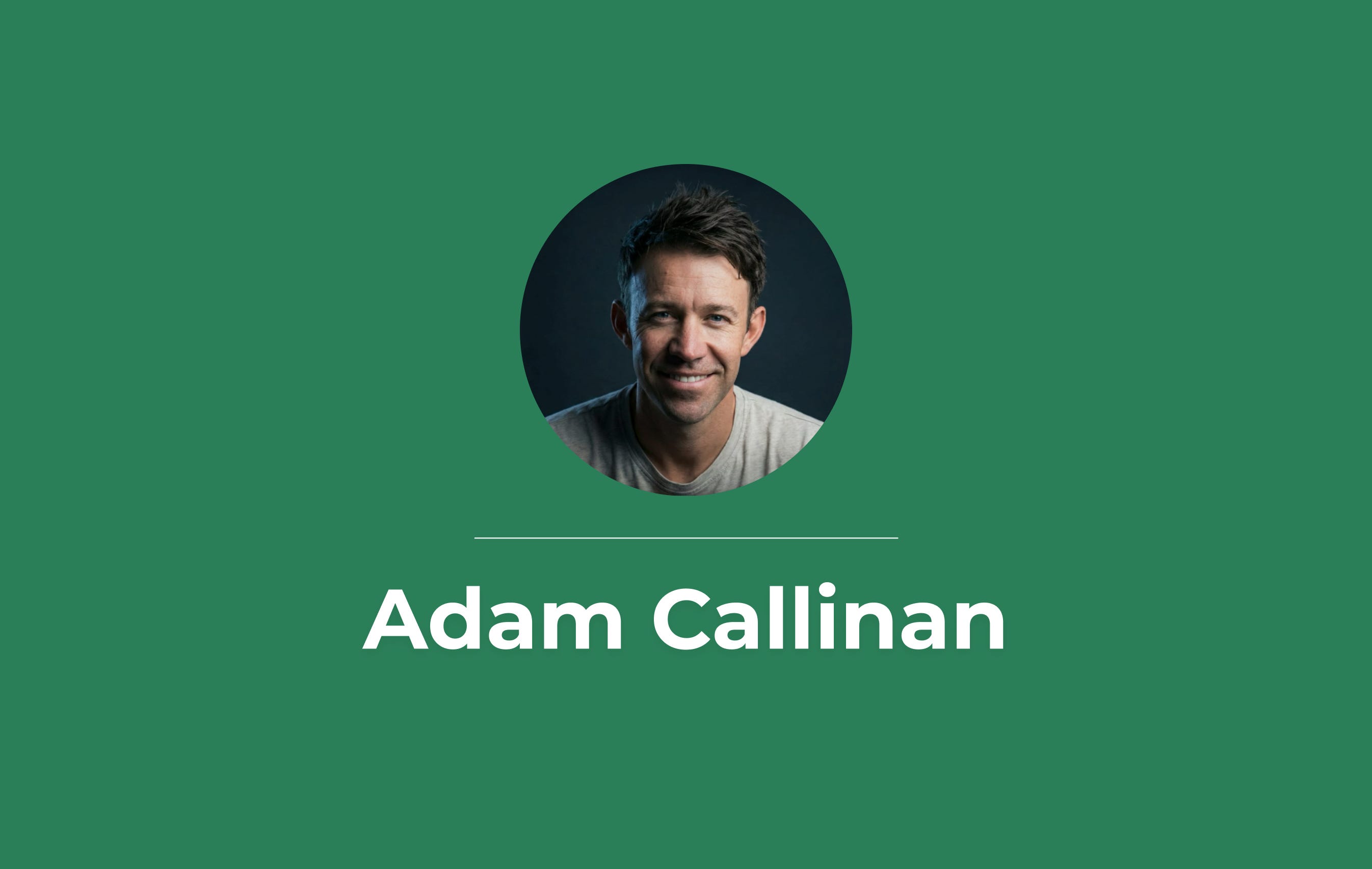
Adam Callinan is the founder and CEO of Pentane, a profitability operating system for e-commerce and direct-to-consumer brands. Pentane emerged directly from the decade Callinan spent building BottleKeeper — a beverage insulator he co-founded with his cousin in 2013 — from zero revenue to $60 million in total sales and a private equity exit, running customer service, paid advertising, creative, and the website almost entirely himself. The core insight behind Pentane: most e-commerce operators are drowning in dashboards but can’t answer the one question that matters — are we profitable, and why — because no one has codified the right equations for them.
BottleKeeper’s growth was neither gradual nor accidental. In August 2014, when Facebook launched its video ad platform, Callinan shot a clip of the product in motion and watched monthly revenue spike from $2,000 to $40,000 to $60,000 to $80,000 to $150,000 in a matter of months. He spent the next several years doing it almost entirely himself — handling customer service, paid advertising, creative, and the website — while his cousin managed finance and fulfillment. The company appeared on Shark Tank before eventually selling to a private equity buyer.
Callinan lives in Bozeman, Montana, where he pursues hard physical experiences outdoors as deliberate mental conditioning — a framework he traces directly to resilience under business adversity. He actively mentors founders and business owners.
Hey,
Thanks for reading this. I mean that. There's a lot of content out there competing for your attention, and you spent some of it here. I hope it was worth it. Even better, I hope it prompted you to think about something differently enough that you'd share it with someone who'd get something out of it too.
I started this podcast because tactics never stuck with me. What stuck were stories — business biographies, autobiographies, the decisions people made and why they made them. The principle only clicks once you know the story behind it.
So I built the thing I wanted to read. Every week I have two conversations with people who build in technology and product. Then I write the essay I wish I could find — one that puts you inside the conversation, through my eyes. What caught me off guard. What I kept thinking about after we hung up. Where the principle actually lives once you strip away the jargon.
I make this for myself first. If you read the way I do, you’ll want it too.
PS — If you want to pitch coming on the show, or you know someone I should talk to, shoot me an email at caden@hey.com with "January752" in the subject line so it gets past my filters. I'm not optimizing for famous guests. I'm optimizing for interesting conversations, even from people who aren't LinkedIn influencers.


