

Listen to this episode on Spotify or Apple Podcasts
Drew Bridewell spent years at LinkedIn and Facebook with no access to the P&L, then watched AI dissolve both the cost of learning the finances and the cost of the design-system maintenance that used to eat the time he would have needed to learn them. What’s left is the thing only designers can do: visualize what doesn’t yet exist with enough specificity that other people see it, align around it, and believe in it.
About a third of the way into our call, Drew Bridewell catches himself mid-thought and reframes the word he’s been using for his job.
“I’ve really shifted into, like, this operator language,” he says, “because as an operator for any business or any company you, you participate in, you need to understand the finances, you need to understand the economics, you need to understand how the company makes money, how they lose money, then, and then also how much it costs to have a team, how much it costs to have AI as a resource.”
He says it the way someone says a phrase they’ve grown into recently. Operator. Not designer. Not head of product & design, which is what his title at GrowthDay said for five years. Operator, with all the inheritance the word carries — that you spend somebody’s money, or you make it, or you don’t, and the people in the room know which.
The shift, when he describes it, isn’t a re-branding. It’s a diagnosis.
“All the things that I love about the, the, like, the foundations and principles of UX don’t even matter if you don’t understand how the company is supposed to operate,” he tells me. “’Cause then you can’t work backwards, you can’t figure out, like, the root of the problems. You’re just basically taking orders.”
Just basically taking orders. He doesn’t put it sharper than that, and he doesn’t have to. The whole career argument designers spent the last twenty years making — that craft matters, that thinking matters, that we should be in the room where the product decisions get made — collapses in front of that sentence. The room was never refusing the craft. The room was refusing the conversation that happens in the language of dollars, and the craft, on its own, couldn’t get there.
I came up through this argument from the other side. I have a human-computer interaction degree. I was a UX-pilled graduate of my design school in the era when companies hired UI talent, not UX talent — when the market rewarded the people who could ship the prettiest screen, not the people who could explain why the screen should exist. I watched designers fight, decade after decade, for the seat. The fight was real and the seat is real. What I underestimated was how much the seat was always financial.
Drew makes it concrete with where he learned it.
“I learned it more as I got further and further away from big tech,” he says. “Because, you know, at, like, LinkedIn and Facebook, I’m not, I wasn’t, like, getting, um... I, I didn’t have access to the, the P&L of those massive companies, but I definitely, you know, we, we’d see the movement, and we had, we had really strong VPs and, and leadership there, but we weren’t, you know, that wasn’t a discussion that designers got to have, uh, and that was a big problem. And I think we would all have been more successful 10 years ago if literally everybody in the company understood the finances.”
That last clause is the breakthrough sentence of the whole conversation. We would all have been more successful ten years ago. Not the designers — all of us. The thing he’s describing isn’t a missing skill on the design side. It’s a structural choice on the company side, made when finance was an expensive specialty and giving everyone a window into the P&L would have been more risk than reward. So the designers spent the decade making craft arguments to people who were having a different conversation in a different language in another room. And the designers who eventually did get into that other room got there by going someplace small enough that they couldn’t avoid the finances anymore — which is the path Drew describes for himself, getting smaller and smaller until the numbers were on the same table as the work.
For a long time, the cost of learning that other language was high enough that it sorted people. You either spent two years and a hundred thousand dollars on a degree that taught you to speak finance, or you accepted that someone else would always be the one in the room translating between the design and the business. That sort was the gate. It wasn’t subtle, and it wasn’t fair, and the people on the inside of it ran most of the companies the designers were trying to influence.
Two things changed in the last couple of years, and Drew has spent his own money learning both of them.
The first is that the financial half of the literacy stopped being expensive. The frameworks and the vocabulary — what a P&L is, what a balance sheet is, how revenue and cost of revenue and contribution margin actually move — are a short course away now. The math you used to need to do by hand is something a spreadsheet does, and the moments where you’d freeze because you didn’t know the next move are moments where you can ask. You don’t need a degree to price a design decision anymore. You need the patience to learn the words and a tool that handles the arithmetic. Drew is matter-of-fact about it. The barrier wasn’t conceptual; it was access. Access just dropped.
The second is that AI removed the other half of the cost — the half nobody was talking about. For most of Drew’s career as a senior design leader, the unglamorous job underneath the title was maintenance. Maintaining the Figma library. Versioning the components. Mediating the requests for new variants. Shipping the tickets that kept the design system internally consistent so the rest of the team could move. That work was real, and necessary, and it consumed exactly the hours a designer might otherwise have spent learning the business.
About a year before our conversation, Drew started paying out of pocket for the maxed-out versions of Claude Code, Bolt.new, and Codex — a hundred to two hundred dollars a month of his own money. He started testing into onboarding funnels at GrowthDay, building variants in Claude Code or Bolt.new, shipping them, watching them, tearing them down. By his count, hundreds of variations in a year. By the end of the year, the engineering team trusted him to migrate to production.
Then he did the thing that’s hard to describe without making it sound either smaller or more dramatic than it was.
“I ended up reproducing our entire, like, Figma, basically Figma design library inside of Cloud Code,” he tells me. He means Claude Code; the audio system has been hearing the brand name as “Cloud” all conversation and I’ve stopped correcting it in my head. “It allowed my CEO or anybody to go and pull from that Git repo and then just ask for anything that you want, and then it would just produce it.”
What he just described is the dissolution of the design-system-maintenance job. Not its outsourcing. Its encoding. Five years of accumulated taste — every button, every type ramp, every brand decision people argued into existence — translated into a system that could produce in the brand’s voice from natural-language prompts. Anyone on the team, including the CEO, could ask for a funnel page or a post and get something brand-consistent back. The library went from a thing a person had to maintain in tickets to a thing the company carried in code. The job that used to eat the senior designer’s week stopped existing in the form that ate it.
And here is the conjunction the conversation hangs on. The two costs that kept designers out of the operator conversation — the cost of learning the finances and the cost of maintaining the system — both dropped at roughly the same time, on roughly the same curve, for roughly the same reasons. What was a permanent trade-off five years ago became, in the course of a year, a choice.
I ask Drew what a designer does with that, once they see it. He doesn’t pause.
“That’s why I think I’ve really shifted into, like, this operator language,” he says again. The word lands differently the second time. The first time he said it, it sounded like an identity move. The second time, it sounds like an point of view about where the work is now.
This is, I notice, the same Drew who introduced himself at the top of the call by giving me a title I hadn’t heard before.
“My name is Drew Bridwell,” he’d said. “I’m now a chief design operator. I’m primarily focused on helping founders bring their visions to life.”
Chief design operator. The compound is doing real work. The design half is the craft — twenty years of Lynda.com and LinkedIn and Facebook and InVision and GrowthDay. The operator half is what he learned the hard way, going small enough that the P&L finally got close enough to read. Sitting between the two is what AI freed him to actually do — visualize, make the unbuilt thing legible, get the people who have to fund it and ship it and sell it to look at the same picture.
Because that last part — visualization — is the thing that doesn’t get cheaper.
The frameworks you can buy. The maintenance you can encode. What you can’t outsource is the act of seeing what doesn’t yet exist with enough specificity that other people can see it too. That’s still a designer’s job, and it’s still rare, and it’s the thing the operator language was supposed to be in service of all along. When a founder is staring at a blank space and a board is staring at the same blank space and the team is waiting to be told which version of the thing to start building, the person who can put something concrete enough on the table for everyone to react to is the person doing the load-bearing work.
That work creates alignment, in the most literal sense of the word. The picture is on the table. We’re looking at it together. We agree this is the thing.
“He had to learn, and he’s not like any other CEO,” he says of Brendon. “He’s like, like a high-performing CEO, so he’s like learning and doing things as well and learning from us ‘cause, you know, I write about all this stuff in my status update every week, right? So I’m like, I’m, I’m a transparent, I’m a transparent beast. Like I’m gonna share it all.”
Transparent beast. He says it without irony. The transparency is how the visualization earns belief — not as a one-shot demo, but as an ongoing public record of the thing coming together. He wrote the weekly status update the whole way through. By the time the design library was in the repo, nobody had to be sold on what they were looking at. They’d been reading the receipts for months. The picture had been forming in their inboxes one Friday at a time, in his voice, on the record, and the day the keys were available the team had already been living in the thing they were now being handed.
What design at the operator level actually does, then, sits on top of both the craft and the finances rather than choosing between them. The work is making something invisible — a strategy, a brand, a year of decisions — visible enough that a roomful of people can agree it exists. Then writing the receipts every week so the agreement isn’t dependent on you being in the room.
There’s a line at the end of our call I keep replaying. Drew is talking about the next twenty years, about the five to ten founders he’ll work with, about the small businesses about to get well-made software for the first time. He says he projects one to two million dollars a year in this next phase. He says it like arithmetic, not a target. And then he adds, almost as an aside, the line that turns out to be the answer to the whole conversation:
“I’m trying to teach the whole system, not, not just one thing.”
The whole system. Not as the sum of the craft and the finances and the picture, but as the practice of holding all three in the same room at the same time. Designers spent twenty years asking for a seat at the table, and what they were really asking for was the conversation the table was having — the one in dollars, the one in trade-offs, the one about what gets built and what doesn’t. The conversation is open now. The seat costs what it always cost. The price just stopped being out of reach.
Guest Bio: Drew Bridewell
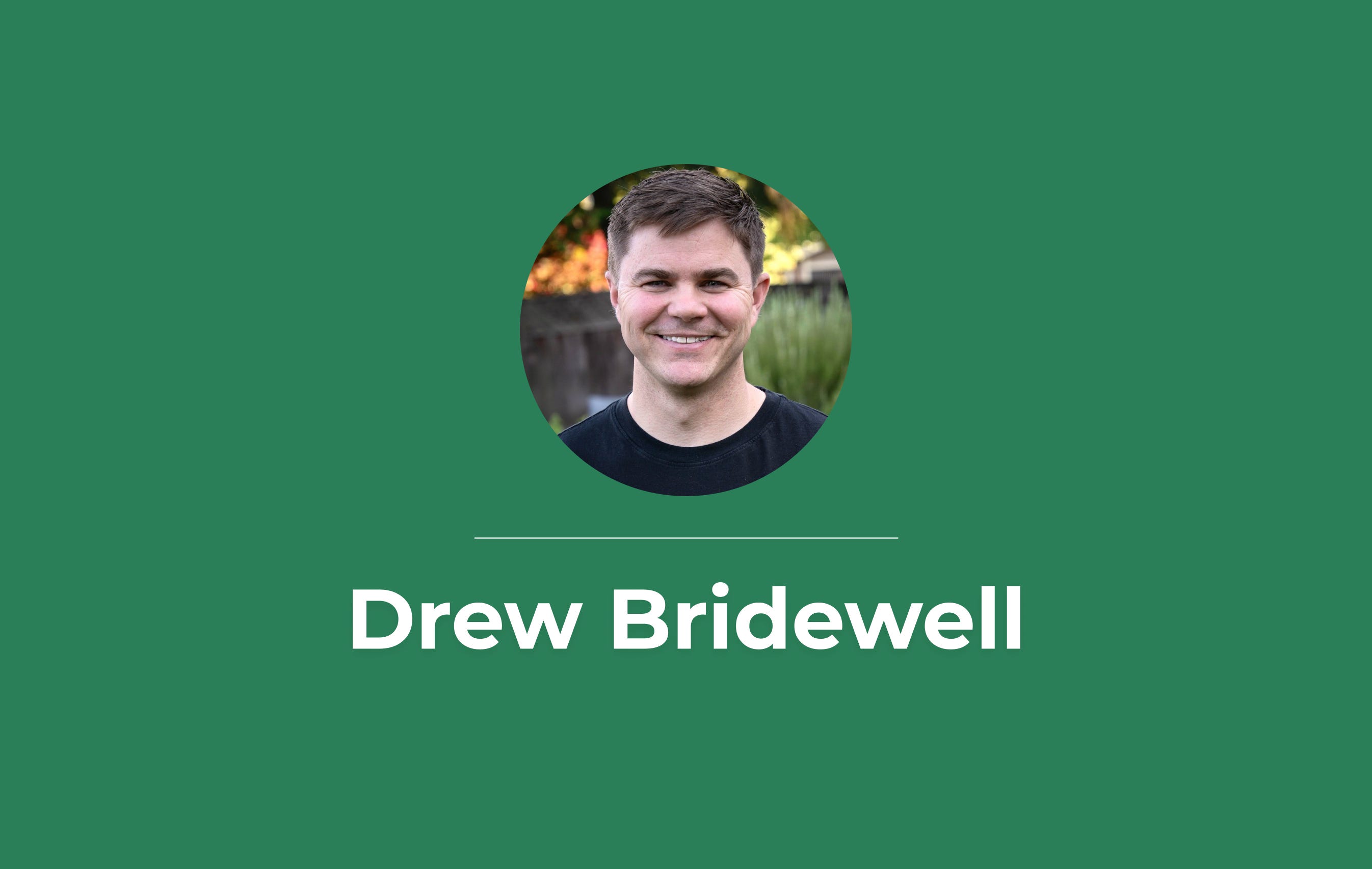
Drew Bridewell is a Chief Design Operator and fractional product design leader, helping founders across industries build custom digital products at a fraction of traditional costs. Rising to prominence in the 2010s as a design educator and systems architect, he became known for bridging the gap between UX craft, business operations, and high-performance team design — a practice built over two decades at companies including LinkedIn, InVision, and GrowthDay. He holds a Certified High Performance Coach (CHPC) credential and is the founder of Next Level UX, an operating system for designers and operators combining 20 years of design practice with research-backed high-performance habits.
Previously, as Head of Product Design at GrowthDay — a personal development platform built around Brendon Burchard’s six high-performance habits framework — Bridewell spent five years leading product experiments, testing hundreds of onboarding funnel variations using Claude Code and Bolt.new, and shipping code directly to production. He rebuilt GrowthDay’s entire Figma design library inside Claude Code, enabling the CEO to self-serve product iteration without a dedicated engineering headcount. Over three years of the engagement, he taught weekly live design and performance frameworks on the platform, reaching the company’s subscriber community of coaches, executives, and high-performance practitioners.
His career highlights include serving on the Design Transformation team at InVision, where he mapped the design systems and organizational maturity of hundreds of enterprise clients. Earlier, at Lynda.com prior to its acquisition by LinkedIn, Bridewell hosted Practical UX Weekly on LinkedIn Learning — a widely-followed series on interaction design principles that introduced a generation of early-career designers to the foundations of UX. He earned his degree from the Savannah College of Art and Design.
As founder of Next Level UX, Bridewell coaches designers, operators, and founders through systems built at the intersection of design thinking and financial literacy — teaching the operator skills that enable practitioners to price design decisions, understand P&L, and deliver at the level of a full product team as a single fractional contributor.
Hey,
Thanks for reading this. I mean that. There’s a lot of content out there competing for your attention, and you spent some of it here. I hope it was worth it. Even better, I hope it prompted you to think about something differently enough that you’d share it with someone who’d get something out of it too.
I started this podcast because tactics never stuck with me. What stuck were stories — business biographies, autobiographies, the decisions people made and why they made them. The principle only clicks once you know the story behind it.
So I built the thing I wanted to listen to. Every week I have two conversations with people who build in technology and product. Then I write the essay in my premium newsletter (Taste Maker) to distill the principles and reflect on the narrative — one that puts you inside the conversation, through my eyes. What caught me off guard. What I kept thinking about after we hung up. Where the principle actually lives once you strip away the jargon.
I make this for myself first. If you read the way I do, you’ll want it too.
PS — If you want to pitch coming on the show, or you know someone I should talk to, shoot me an email at caden@hey.com with "January752" in the subject line so it gets past my filters. I'm not optimizing for famous guests. I'm optimizing for interesting conversations, even from people who aren't LinkedIn influencers.


