

Listen to this episode on Spotify or Apple Podcasts
“I’ve got a quick example if I got time for it,” Vance Morris says. “Is that okay?”
It’s his interview. I tell him to go ahead.
So he tells me about an insurance agency. He’d been brought in to fix one specific thing: the way they answered the phone. It sounds small until you realize that answering the phone was the agency’s number one source of new business. Every lead came through that one ringing line, and the people picking it up sounded like everyone else who has ever picked up a phone. “Thank you for calling Dave’s Insurance. How can I help you?” Pleasant. Forgettable. Indistinguishable from the agency across the street and the one across the country.
Then Vance walked into the owner’s office. Gold records on the wall. Autographed guitars. The man was a rock and roll fanatic, and his entire personality was hanging there in frames, and nobody had thought to let it leak into the business. “We should really lean into this personality a bit,” Vance told him. And then comes the part Vance wants me to hear: the fix came from the receptionist. The idea was to answer the phone by channeling Wolfman Jack, the rock-radio howl. From then on, the phone got answered a different way.
“Thank you for calling Dave’s Allstate, the agency that rocks.”
I laugh, because it works, and because it’s the kind of thing that sounds like a gimmick until you sit with it for a second. Vance has clearly sat with it for longer than a second. He breaks it apart for me like he’s done it a hundred times, because he has. What to do: answer the phone. How to do it: the agency that rocks. And then he slows down on the third one, the one he actually cares about.
Why do we do it that way?
“Your marketing is designed to do two things,” he says. “Attract the people you wanna do business with and repel the people you don’t.” Answer the phone like a rock station and you start sorting your callers before they’ve said a word. The people who smile are your people. The people who frown and hang up were never going to be easy clients anyway. And underneath the sorting, there’s a second thing happening, which is that nobody else in the country is answering the phone that way, so the agency has quietly become the only one of its kind. “He owns it,” Vance says.
That’s when he gives me the line I anchor on. The why is what lets your employees “really have something that they can wrap their brains around.”
I want to stay on that, because I think it’s the whole interview hiding inside a phone greeting.
Vance spent about ten years at Walt Disney World. He was on the opening teams for the Yacht and Beach Club, for Pleasure Island, for Animal Kingdom, and his signature build was Chef Mickey’s, the character dining experience at the Contemporary Resort. He is, by his own cheerful admission, a lousy employee. “I just don’t like to be told what to do,” he tells me near the top of our conversation, which puts him “in the unemployable realm of things.” A man like that staying somewhere for a decade is worth paying attention to. He didn’t stay because Disney told him what to do. He stayed because, for nine and a half of those years, Disney was building things, and he got to build them. He was on the opening team. There was creation going on, and systems and processes being invented rather than maintained, and that was the work that held him.
And then it stopped, and that’s the part that should make every executive nervous. Growth slowed. “Processes and systems were just being managed as opposed to being created,” he tells me, and I can hear the moment land in his telling. “That’s where I kind of start to feel, eh, I’m not feeling overly creative anymore. I should look somewhere else.” Nothing went wrong. No one mistreated him. The company simply finished its 20 percent and settled into running the 80, and the man whose whole value was the 20 percent felt himself becoming redundant in a building that no longer needed anyone to invent anything. So he left. The lesson cuts both ways: the 20 percent isn’t only where you differentiate your product. It’s where you keep the people who can build the next one.
But the thing he carried out the door wasn’t the magic. It was the plumbing.
“Disney runs on systems and processes,” he says, and he knows how that lands. He knows the word “process” makes people picture employees behaving like robots, creativity drained out of them by a checklist. He thinks that’s exactly backward. “If you design a great process, an extraordinary process, it’s gonna deliver an extraordinary result.” That’s how a company gets 75,000 employees all singing the same song. There’s a process for waiting on a table. There’s a process for changing a bus tire. There’s a process for nearly everything, and the processes are simple, and that simplicity is the point.
Here’s the mechanism he describes, and it’s the part that reorganized something in my head. When the job becomes muscle memory, what he calls “muscle reflex memory by rote,” you stop spending your attention on the job. “It gives your brain 20 to 25% excess capacity,” he says, “’cause you’re not thinking about your job, you’re just doing it.” The systems aren’t there to make people smaller. They’re there to free up the exact slice of a person that the company actually wants: the part that takes the photo, gives the directions, signs the autograph, notices the kid who dropped his ice cream. The 80 percent runs itself so the 20 percent can show up.
Vance took that home and pointed it at three businesses nobody dreams about as a kid: carpet cleaning, mold remediation, an Oriental rug washing facility. He built a marketing system, a retention system, an operations system. He hired a general manager and gave him a single instruction. “Just manage the systems. Don’t screw with anything, just manage the systems.” They meet for an hour every Friday morning at 7:30 to talk through any improvements, and then the manager marches off and executes. Vance spends the other half hour of his week on the accounting, because he doesn’t let anyone touch the checkbook. Ninety minutes a week, total, on three companies. That’s what a well-designed 80 percent buys you.
I tell him what I think I’m hearing, because by now I can feel a shape forming. You systematize the 80 percent, the table stakes that don’t set you apart, precisely so you can stop sweating it. And the reason you tell employees this isn’t to keep them in their lane. It’s to draw the lane on purpose. This part is table stakes, so don’t waste your creativity reinventing it. This other part, the 20 percent, is where we actually compete, and that’s where we need your brain.
“Yeah,” Vance says, and he starts listing the companies that live this way. The Ritz-Carlton. Harley-Davidson. Apple. Each of them has the systems-and-processes piece locked down, and each of them also has the part that asks, constantly, “How do we make this thing better? Or how do we make it completely new?” They go hand in hand. And then he tells me where most people get it wrong, which is by giving the creative part too much room. “20% is enough,” he says. “’Cause otherwise you’re just going off in a myriad of directions and you kind of just flounder around and get lost.”
This is the trap I’ve watched product teams fall into from the other side. They systematize the wrong fifth. They build rigid process around the very thing that’s supposed to set the company apart, and they leave the table stakes to improvisation, so the differentiator calcifies while the basics stay sloppy. It’s the inversion of everything Vance is describing. The phone greeting gets standardized into beige, and the actual personality — the gold records on the wall — never makes it into the building.
What strikes me, sitting with all of it, is that the three words aren’t really a management framework. They’re a way of treating people like they can hold an idea. Most businesses stop at two because two is enough to get the task done. You can tell someone what to do and how to do it and the phone will get answered. But you’ll have built a person-shaped machine, and machines don’t channel their inner Wolfman Jack. The third word is the one that says: here is the reason this matters, and I trust you to do something with it.
And the proof, in Vance’s story, isn’t him. It’s the insurance company owner that had an affinity for rock and roll.
Vance didn’t hand down a script. He gave the owner a why: lean into who you actually are. And somewhere down the chain, a person who answers the phone for a living heard that why and invented the how. The agency that rocks.
That’s the line still ringing at that office, and no consultant wrote it. Someone who finally understood the “why” did.
Guest Bio: Vance Morris
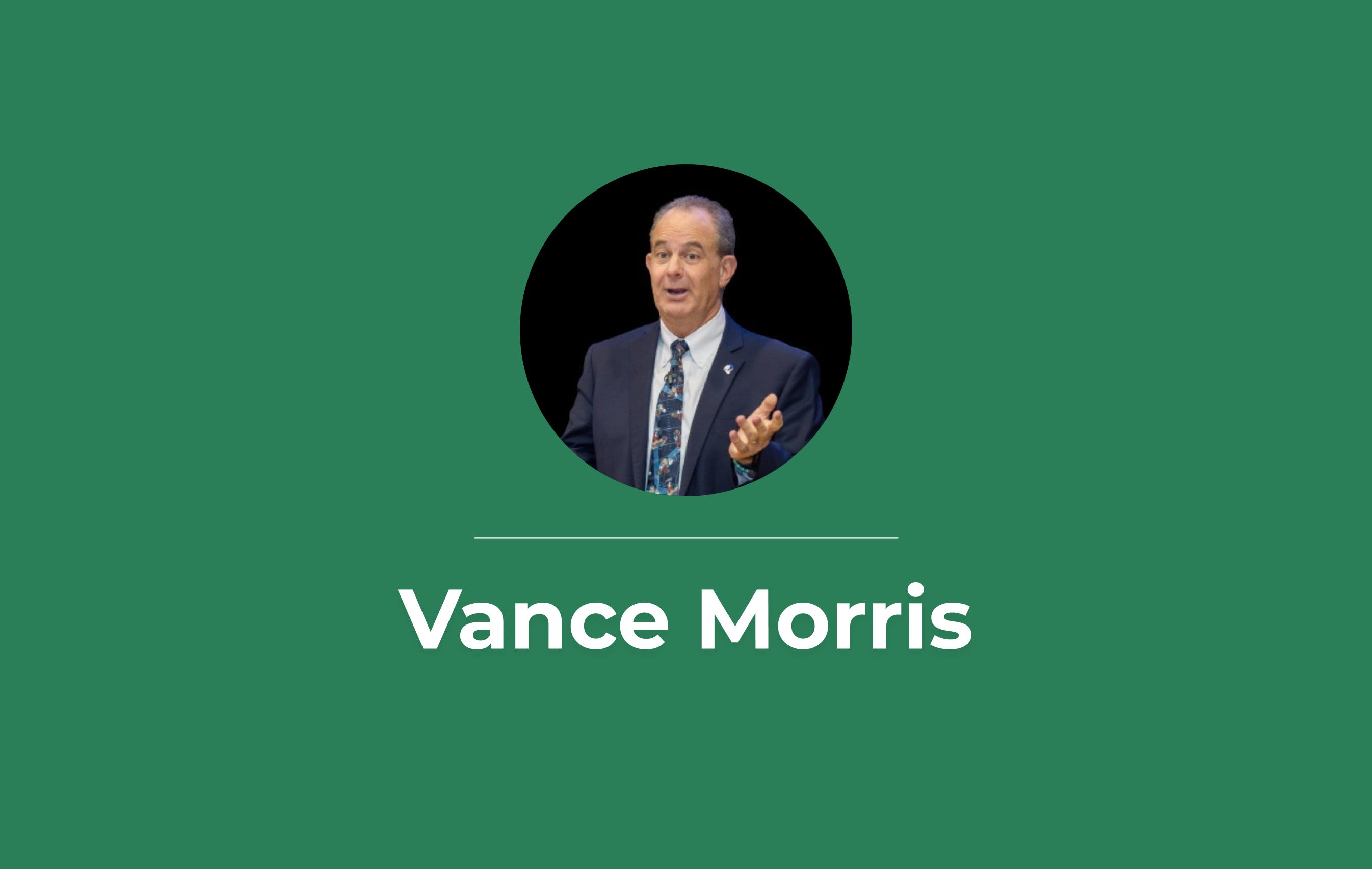
Vance Morris is the Founder of Deliver Service Now!, a consulting and coaching firm that teaches small and midsize businesses how to implement Disney-caliber customer experience systems combined with direct response marketing. Rising to prominence through a decade of leadership at Walt Disney World, he became the creative lead behind Chef Mickey’s — Disney’s flagship character dining experience at the Contemporary Resort — a concept whose systems have remained largely unchanged for more than 25 years. He also built and systematized three home service businesses in Maryland (a carpet cleaning company, a mold remediation company, and an Oriental rug washing facility) to operate on 90 minutes of his attention per week.
Previously, as a manager and trainer at Walt Disney World through the 1990s expansion era, Morris served on the opening teams of the Yacht & Beach Club Resorts and Animal Kingdom, and acted as All-Island Duty Manager at Pleasure Island. He was recognized for generating $125,000 in business from a single marketing campaign, earning the Marketer of the Year award at a GKIC competition in 2015 and an International Marketing Award in a Dan Kennedy competition.
His consulting client roster has included NASA, the Smithsonian, the Kennedy Center for the Performing Arts, Legal Seafoods, Tyson, Rainforest Café, and Compass Group. He has shared stages with Daymond John, Dan Kennedy, Joe Polish, and Jack Canfield across more than 40 years of speaking experience.
Morris is also the creator of 52 Ways to WOW Your Customer, a free resource delivering one customer experience tactic per week of the year.
Hey,
Thanks for reading this. I mean that. There's a lot of content out there competing for your attention, and you spent some of it here. I hope it was worth it. Even better, I hope it prompted you to think about something differently enough that you'd share it with someone who'd get something out of it too.
I started this podcast because tactics never stuck with me. What stuck were stories — business biographies, autobiographies, the decisions people made and why they made them. The principle only clicks once you know the story behind it.
So I built the thing I wanted to read. Every week I have two conversations with people who build in technology and product. Then I write the essay I wish I could find — one that puts you inside the conversation, through my eyes. What caught me off guard. What I kept thinking about after we hung up. Where the principle actually lives once you strip away the jargon.
I make this for myself first. If you read the way I do, you’ll want it too.
PS — If you want to pitch coming on the show, or you know someone I should talk to, shoot me an email at caden@hey.com with "January752" in the subject line so it gets past my filters. I'm not optimizing for famous guests. I'm optimizing for interesting conversations, even from people who aren't LinkedIn influencers.


