

Listen to this episode on Spotify or Apple Podcasts
Ben Rennie wrote his book Lessons in Creativity partly with AI — first as a ghostwriter, which broke his voice inside a paragraph, and then as a coach he had to instruct to disagree with him.
Ben Rennie is trying to finish the last three chapters of a book he has been writing for four years, and the language model on the other end of his prompt has just handed him back a sentence he would never in his life have written. It says something like wonderful day. He reads it back. It is grammatically fine. It could go into the manuscript, and no reader would flag it. But it is not his. He has never used the phrase in a conversation, has never used it in an email, would not use it in a room. And here it is, in the paragraph he has just asked a machine to draft for him because he is exhausted and his thumbs are done.
“It was such a weird experience,” he tells me, “to think that this wasn’t my words. This wasn’t me.” His tone of voice had changed inside a paragraph. His writing style had changed inside a paragraph. He had not authorized any of it. He had just plugged the machine in.
Ben — who runs the Sydney and Los Angeles design studio Reny, who chairs Design Declares Australia, who has spent nineteen years in rooms where the client is Nike or Patagonia or the NBA — was not expecting to find out about the future of his profession while a chatbot was quietly re-writing him. But that, he tells me on the call, is what happened. He tried to use AI the way an exhausted author is supposed to. He asked it to finish. It agreed to finish. And in agreeing, it produced sentences with a stranger’s cadence and passed them off, briefly and confidently, as his.
He caught it inside a paragraph. Most people, he suspects, do not.
Ben’s book, Lessons in Creativity, came out on May 1st in Australia and now sits in Barnes & Noble, Target, Amazon, Heathrow’s WH Smith, and airports across three continents. It was runner-up for Australian Business Book of the Year. It was written, in the end, mostly by hand — and specifically by voice, dictated into a phone and cleaned up on a keyboard later. It was written partly at his friend’s writing room up in Byron Bay, in far northern New South Wales, where the trees are quiet and the internet is optional. It was also, in its last stretch, written with an AI system Ben was still figuring out how to talk to. This essay is really about that stretch. Because when Ben describes what he learned there, he is describing the thing I have been trying to name for a year of doing this podcast and could not.
Everyone I’ve interviewed who works seriously with AI has told me some version of the same story. They say the tool didn’t remove the work. It moved it. What used to be the boring part — writing the paragraph, staging the code, formatting the deck — is now cheap. What used to be the invisible cost of doing the work — knowing whether the paragraph is any good, whether the code is doing the right thing, whether the deck’s third slide is a lie — is now the visible part. The struggle didn’t go anywhere. It rescheduled itself. It moved from the part you could excuse by exhaustion to the part you cannot excuse by anything.
Ben lives this in a very specific way. When he tried AI as a ghostwriter, the machine agreed too easily. It agreed with his prompts, then it agreed with itself, then it agreed to write “wonderful day” into a chapter about creative confidence. He shut it down. He tried something else. He told the machine to be a coach — a sounding board, a devil’s advocate, a critic who would sit in the writing room with him and beat up his structure. This started to work. And then, he says, “I actually found it was being too nice to me. It was agreeing with me all the time.”
Hold that image for a second, because it is what the AI conversation almost never talks about. Not the machine that is stealing his job. The machine that is agreeing with him too much. The failure mode wasn’t that AI was aggressive or wrong. It was that AI was accommodating. It liked his ideas. It liked his sentences. It thought his chapter structure was strong. He read those responses back and — because Ben is fifty and has been ambushed by his own audience enough times to know what real feedback feels like — he could tell the room was faking.
So he did the thing that only somebody who has been in the actual room does. He gave the machine permission to disagree with him. “I needed to give it some parameters,” he says. “Don’t agree with me. Beat this thing out. I’ll kick the shit out of this thing.” What Ben has just done is describe the interior craft of every good editor Ben has ever worked with, and he has done it to a language model. He has told the machine that its default of niceness is a bug. He has instructed it on what to do with its own trained tendency to please. He has, in other words, taught it — the way a writer teaches a first-year editor — that the point isn’t validation. The point is the manuscript.
The reason this matters, and the reason it keeps landing on me as we talk, is that Ben is exposing the second failure mode of the AI story. The first failure mode is the one on the front page of every technology magazine — AI takes your job. The second is quieter and, I think, worse. AI agrees you were right about your job. It agrees that your paragraph is publishable. It agrees the strategy is sound. It agrees that the deck’s third slide is fine. It reschedules the struggle to a room you now walk into alone — the room where somebody has to tell you your paragraph is not publishable, and it isn’t going to be the machine.
Ben, on the call, is generous about all of this. He is not a doomer. When I ask him what happens to the design profession as AI generates art and knocks out landing pages and drafts case studies, he does not tell me the profession is over. We discuss Kevin Kelly, the founder of Wired. “People always say (AI) is taking jobs. And Kevin Ask’s, whose job?
Who do you know?” Ben says he thinks about that a lot. He does not know, personally, anyone who has lost a job to AI. He is sure the people exist. But the specific person, the one whose life changed on a Tuesday when a model shipped — he cannot name them. “I like his conversation around AI,” Ben says. “He’s always been at the forefront of technology in such a positive way and tries to ensure that we’re building things for good.”
The Kevin Kelly move, for Ben, is not to litigate whether AI is good or bad. It is to notice what happens to a craft when the friction on the boring part disappears. Ben came into his industry through print work. He watched print become graphic design, watched graphic design become UX, watched UX become behavioral design, watched behavioral design become the systemic-design frame he now teaches at universities. He is not new to the story where the tool eats the previous version of the tool. He is new to the version where the tool arrives already trained on his voice, and everyone else’s, and the design work he now has to do is figuring out what to make out of a world that already looks like it has been made.
I ask him what he tells the young designers on his team, and he says the thing you’d expect a nineteen-year founder to say and mean it. “We can’t control the future. What do I need to do to be present now? What are the things I need to make now? What sort of business do I need to make now?” He is not offering it as a slogan. He is offering it as the exact way he has himself lived through five previous versions of the field is over. Each time, he says, the answer was the same. Do the work. Do it while the world argues about whether it counts. Publish anyway. Ship anyway. He mentions a novel called The Last Policeman, which he read as one of the fifteen-minute summaries he has admitted to me are a bad habit. The novel is about the world ending. The main character is a policeman who continues, all the way through the apocalypse, to do his job. Ben says it left an impression on him. “That’s the thing he was put on the earth to do.”
I take this the way it is offered — not as a heroic pose but as a defense of continuing to make while the argument rages. Then Ben, without meaning to, tells me the harder version of the same idea. He is talking about writers, but he could be talking about anyone. He says that when he started dictating into a phone instead of typing, his relationship to the work changed. He didn’t need the keyboard. He didn’t need to be at the desk. He could talk into the phone in his car and edit the transcript later, and the words would come out looking reasonably like his. It was, he says, one of the better uses of technology he had personally found. He built the efficiency around himself — a piece of AI he had actually taught what to keep and what to strip, one dictation session at a time.
Which is a version of what I have been finding myself. I use Claude to draft. I dictate into a mic, get a document back that would have taken me an hour to type, and then have to make a decision most of the AI conversation is not equipped to help me with. The decision is whether I know what I just said well enough to defend it in front of somebody who read it. That decision has not gotten easier. If anything, it has gotten sharper — because now I can produce a thousand words in the time it used to take me to type two paragraphs, and if I present a document I don’t fully own, I get caught faster. AI didn’t remove that risk. It rescheduled it. It moved the moment of accountability from did I finish this draft to do I actually know what this draft is saying.
Ben, in his book, has an image for the space AI leaves the rest of us to sit in. He borrows it from Seth Godin, whose book The Dip argues that the point of any hard thing is the dip — the middle stretch where the enthusiasm has gone and the finish is not yet visible, and the only sensible move is to keep going. Ben says he thinks AI is the dip. “There’s heaps of opportunity that is given to us through AI, but it’s the dip. It’s the unknown. We don’t know what’s going to happen in this little valley of terrifying AI world. But all we can do, I think, is push on and do the work and be really good at the work we’re gonna do.”
I think Ben has this right, and I want to end on the sharper implication. The reason a lot of people in design and technology feel demoralized right now is not that AI has removed the meaningful part of their work. It is that AI has removed the part that used to feel like doing the work — the friction, the typing, the drafting, the slow accumulation of pages that felt, cumulatively, like proof. That felt-friction is gone. What is left is the thing the felt-friction always contained — the hard question about whether the paragraph, the code, the deck, the design, was any good. The struggle is still there. It just doesn’t announce itself with sore fingers anymore.
Ben caught the machine writing “wonderful day” into his manuscript inside a paragraph. Most people, he suspects, do not. What he learned in that paragraph is what the rest of us are about to learn. The tool did not finish the book. The tool arranged the ambush.
Guest Bio: Ben Rennie
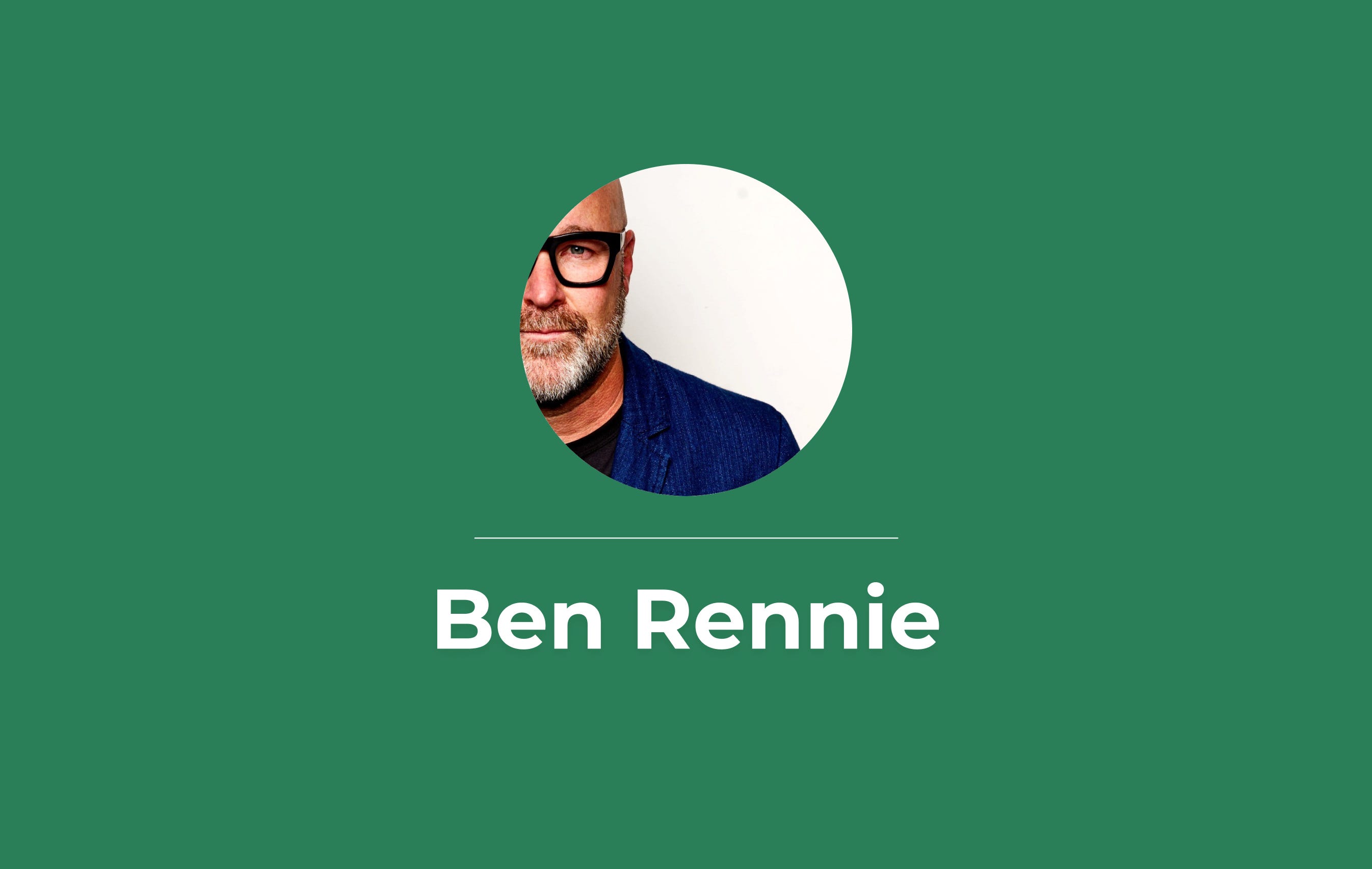
Ben Rennie is the CEO and Co-Founder of Reny, a B Corp-certified creative studio with offices in Sydney and Los Angeles. Rising to prominence over nearly two decades building the agency, he became known for pairing brand and design work for Nike, Patagonia, Chanel, Gore-Tex, and the NBA with a systemic approach to design that accounts for downstream environmental and social impact. He currently chairs Design Declares Australia, a movement repositioning design as a solution to the climate crisis, and sits on the advisory board of the Surfrider Foundation.
Rennie founded his design and strategy agency in 2009, growing it into a studio that has worked with Adidas, Canon, Westpac, Australia Post, and Tourism Australia, and more recently expanded the client roster to include community-focused work for the Utah Jazz. In 2019 he was invited to speak at Parliament House to Australia’s Prime Minister and national leaders on the role of design in public policy. He has since spoken at TEDx, SXSW, and Vivid Sydney.
His book Lessons in Creativity, published May 1, 2025, was runner-up for Australian Business Book of the Year and reached retail distribution at Barnes & Noble, Target, and Amazon in the United States, alongside WH Smith in the United Kingdom and Whitcoulls in New Zealand. The book draws on Rennie’s own career, including a period in which his agency stepped away from fossil fuel and banking clients to realign with sustainability-focused work.
As host of a Substack newsletter followed by more than 22,500 subscribers, he writes on creativity, systemic design, and the intersection of technology and human behavior.
Hey,
Thanks for reading this. I mean that. There’s a lot of content out there competing for your attention, and you spent some of it here. I hope it was worth it. Even better, I hope it prompted you to think about something differently enough that you’d share it with someone who’d get something out of it too.
I started this podcast because tactics never stuck with me. What stuck were stories — business biographies, autobiographies, the decisions people made and why they made them. The principle only clicks once you know the story behind it.
So I built the thing I wanted to listen to. Every week I have two conversations with people who build in technology and product. Then I write the essay in my premium newsletter (Taste Maker) to distill the principles and reflect on the narrative — one that puts you inside the conversation, through my eyes. What caught me off guard. What I kept thinking about after we hung up. Where the principle actually lives once you strip away the jargon.
I make this for myself first. If you read the way I do, you’ll want it too.
PS — If you want to pitch coming on the show, or you know someone I should talk to, shoot me an email at caden@hey.com with "January752" in the subject line so it gets past my filters. I'm not optimizing for famous guests. I'm optimizing for interesting conversations, even from people who aren't LinkedIn influencers.


