

Listen to this episode on Spotify or Apple Podcasts
Rob Walling has invested in 211 SaaS companies, runs MicroConf, and sold Drip in 2016 without ever taking venture money. His 1-9-90 rule says only 1% of startups should raise VC — and that the rest of us have been brainwashed by what he calls the venture industrial complex. He includes himself in the brainwashed.
Rob Walling is saying no, and he is not saying it once. He lines the noes up, one after another, the way you wave off a stack of bad ideas being slid across a table at you.
“It’s like, no, no, no, no, no,” he says.
What he is refusing is a story. The story goes like this: you have an idea for a software company, so you raise money, and you try to become Uber, and then you try to become Facebook, and if you do not clear that bar you have failed. Rob has spent twenty-five years and six companies demonstrating that the story is optional, and he still cannot quite get over how many people accept it as physics.
“This bullshit narrative,” he calls it, “that everybody who does a startup has to raise funding. It’s just not true.”
He has a rule for this. He says it the way a man says a thing he has said on a hundred podcasts and still means. Of all the software startups that get born into the world, he figures about one percent should even consider raising venture capital. About nine percent should consider some other kind of funding — friends and family, an angel round, the non-venture money he runs an accelerator to provide. And the rest, the ninety percent, should bootstrap. One, nine, ninety. He can recite it in his sleep.
The number that stops me is not the ninety. It is the one.
Because I have spent my whole adult life inside an industry that behaves as if the number is closer to a hundred. I have watched roadmaps get bent toward whatever story raises the next round. I have watched a marketplace feature get greenlit not because customers wanted it but because marketplaces carry higher valuations. And I got, as I tell Rob somewhere in the middle of our conversation, red-pilled on the whole thing when all of my friends got laid off at once. I got lucky. I kept my job. But I watched a year of other people’s lives get spent chasing a valuation multiple, and I could not un-see it after that.
Rob has a longer version of the same disillusionment, and he dates it precisely.
“The venture industrial complex has brainwashed us all,” he says. “Me included, back in the early 2000s.”
That last clause is the one I keep turning over. He does not exempt himself. He is not standing outside the machine describing it to me from a clean distance — he is a former believer, someone who once assumed, like everyone around him, that the only way to build something real was to raise buckets of money and swing for a decacorn. The 1-9-90 rule is not a theory he arrived at in a business-school seminar. It is the shape of a mind that changed.
Here is the part the venture story cannot account for, the part Rob keeps returning to. There are, by his count, fifty or sixty thousand B2B SaaS companies in the world doing real revenue. Boring ones. Companies that started as an email tool or an invoicing utility or a scheduling widget and grew into businesses that pay their founders extremely well. None of them will ever be written about. None of them will trend. They are, he says, and this is the image I cannot shake afterward, like an iceberg under the water.
“If folks go to tinyseed.com slash portfolio,” he tells me, “they can see, I don’t know, there’s like boring B2B SaaS businesses that I’ve invested in. And it just gives you an idea of the types of things, the niches you can be in.”
The tip of the iceberg is the part everyone sees. The Ubers. The Facebooks. The companies that raise enough money to buy the attention. What Rob spends his days doing — through TinySeed, the accelerator he built for exactly these founders, and MicroConf, the conference he has run for the bootstrapped crowd for over a decade — is funding the part underwater. The mass of it. The businesses that do not photograph well.
Drip was one of them. It is the proof he reaches for when I ask him to make the abstract concrete, and it is worth sitting inside the story for a moment, because it is the whole argument in miniature. In 2012 Rob wanted a small email-capture widget for websites. He and his co-founder Derek Reimer built it. It did not take off. It took fourteen months of grinding — nine of them after the public launch — to reach what Rob considers strong product-market fit, and even that came only after he made a hard call on incomplete information and turned an email tool into a marketing automation platform.
What made it work was not a war chest. It was a gap. On one side sat the cheap, dumb email tools — MailChimp, AWeber, Constant Contact — none of which could automate anything. On the other side sat the expensive marketing automation platforms, the Marketos and Infusionsofts, with their four-hundred-dollars-a-month floors and their two-thousand-dollar onboardings and their annual commits. In between was a whole population of people who just wanted to pay fifty or a hundred bucks a month and not talk to a salesperson. Drip slid into that middle. No venture money required. Just a founder who had been listening long enough to hear the gap that nobody was filling.
“It wasn’t luck,” Rob says, and then, because he is honest, he immediately complicates it. “I also happened to see the gap.”
We spend a while on luck, because Rob refuses to pretend it did not matter and equally refuses to let it become the whole explanation. His framing is the cleanest I have heard. Luck, he says, is a multiplier. Not a cause — a multiplier. It scales whatever you have already built. He points at Basecamp, at Jason Fried and DHH, whom he once asked directly why the company succeeded. Their answer was luck and timing, one and two. But Rob does the arithmetic underneath the modesty. Basecamp is doing, he guesses, somewhere north of a hundred million a year. Strip the luck out entirely and you are still looking at a ten- or twenty-million-dollar business.
“It’d still be a great fucking business,” he says.
That is the sentence the venture narrative has no slot for. A great business that is merely great. A ten-million-dollar-a-year company that will never be a headline and will make its founders wealthy and free for the rest of their lives. Rob mentions, almost in passing, DHH describing how he and Fried simply split four million dollars off the bottom line at the end of a year — the kind of number you do not get to keep at a venture-backed startup, where the money belongs to the next round before it ever reaches you.
The whole time we talk, I keep thinking about opportunity cost, because that is what the venture story actually costs the ninety percent who buy it. Not just the companies that raise and fail. The ones that raise and, in doing so, agree to chase a size they never needed, on someone else’s timeline, until the thing that could have been a wonderful ten-million-dollar business gets managed into the ground reaching for a hundred. You can pull profit out of a bootstrapped company every year it exists. You can sell it someday if you want. Either way it belongs to you, and the decisions belong to you, and nobody in a board meeting gets to bend your roadmap toward a multiple.
Rob is not anti-ambition. This is the thing people miss about him. He wanted, badly, to build a multimillion-dollar business, and he did it more than once. He is anti-VC-narrative. He is against the single story that got installed in all of us — him first, back in the early 2000s — that says the raise is the beginning of the journey and the size of the raise is the measure of the ambition.
Near the end I find myself thinking about the founders he funds. The ones building something niche and unglamorous, the invoicing tool, the scheduling widget, the boring vertical SaaS nobody will ever cover. They are not failing to be Uber. They were never trying to be Uber. They are down under the surface where most of the actual water is, building businesses that will quietly make them free, and the only reason it looks like nothing is happening down there is that the part of the ocean we photograph is the tip.
Rob spends his life pointing at the water under the tip. Ninety percent of it, by his count.
Guest Bio: Rob Walling
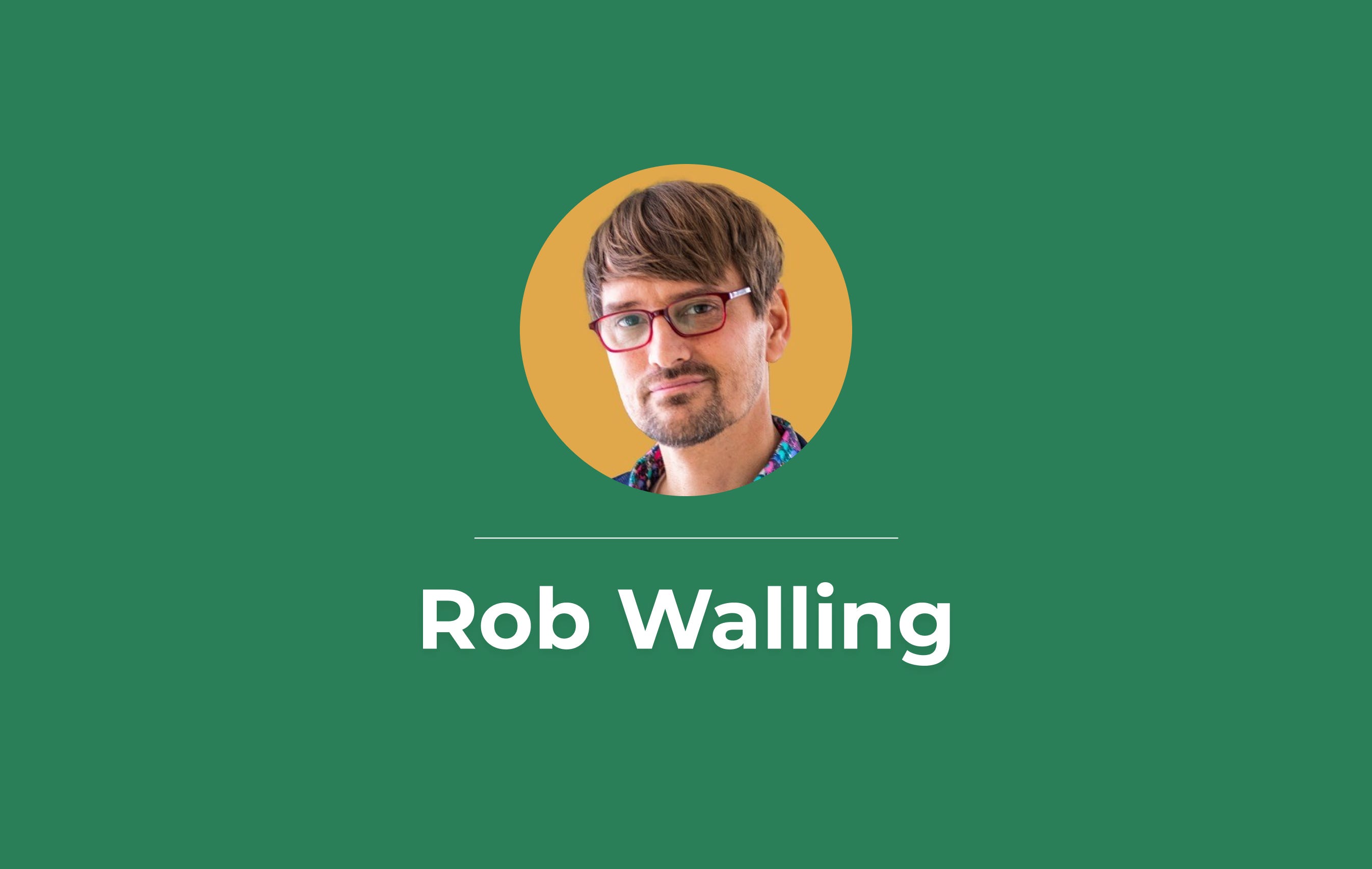
Rob Walling is the Co-Founder of TinySeed, a year-long remote accelerator for bootstrapped and non-unicorn SaaS founders, and the Founder of MicroConf, the original community for self-funded software entrepreneurs. Rising to prominence in the mid-2000s through prolific writing and podcasting, he became one of the most recognized voices in the bootstrapped SaaS movement — widely regarded as the practical counterpoint to the venture-capital-centric startup narrative.
Previously, he co-founded Drip, an email marketing and automation platform, in 2012. Alongside co-founder Derek Reimer, he bootstrapped Drip from a small email capture utility to a full marketing automation suite, achieving strong product–market fit after 14 months of grinding and eventually reaching millions in annual recurring revenue. Drip was acquired by Leadpages in 2016, the liquidity event Rob has described as his “never have to work again” moment. Through TinySeed, which he founded with Einar Vollset, he has since funded more than 200 SaaS companies, with a reported millionaire rate of 43% across the portfolio.
His earlier career included developer-for-hire roles at a credit card company, a startup, and a consulting firm in the early 2000s, followed by a stint as a real estate investor (four properties, seven units in Los Angeles) before fully committing to bootstrapped software. His first small software win, NET Invoice — invoicing software that generated $2,000–$4,000 per month — proved the model was viable without outside funding.
As host of Startups for the Rest of Us, a weekly podcast he has published without interruption since 2010, Rob has shipped over 738 episodes and accumulated more than 15 million downloads. He is also the author of Start Small, Stay Small (2010), a foundational text for developer-entrepreneurs, and The SaaS Playbook (2023).
Hey,
Thanks for reading this. I mean that. There’s a lot of content out there competing for your attention, and you spent some of it here. I hope it was worth it. Even better, I hope it prompted you to think about something differently enough that you’d share it with someone who’d get something out of it too.
I started this podcast because tactics never stuck with me. What stuck were stories — business biographies, autobiographies, the decisions people made and why they made them. The principle only clicks once you know the story behind it.
So I built the thing I wanted to listen to. Every week I have two conversations with people who build in technology and product. Then I write the essay in my premium newsletter (Taste Maker) to distill the principles and reflect on the narrative — one that puts you inside the conversation, through my eyes. What caught me off guard. What I kept thinking about after we hung up. Where the principle actually lives once you strip away the jargon.
I make this for myself first. If you read the way I do, you’ll want it too.
PS — If you want to pitch coming on the show, or you know someone I should talk to, shoot me an email at caden@hey.com with "January752" in the subject line so it gets past my filters. I'm not optimizing for famous guests. I'm optimizing for interesting conversations, even from people who aren't LinkedIn influencers.


