

Listen to this episode on Spotify or Apple Podcasts
Somewhere there is a phone call happening that Ashley Aruffo will never sit in on, and it is the call her whole company exists to produce.
A buyer at some large manufacturer is on the line with one of its suppliers. Routine check-in, the kind that usually runs on pleasantries. And then the buyer says something that is not on the agenda, which is that the supplier’s financial viability is looking a little weak, and here are the five reasons why.
There is a beat on the other end.
“Whoa. How’d you know that?”
Ashley delivers the supplier’s line with the timing of someone who has heard it relayed back to her many times. “That’s that special moment,” she says, “where you’re like, ‘Okay. I would’ve never known to ask that question,’ and it’s true, and it’s been validated, and there’s a little bit of shock.”
I want to be precise about what is strange here. It is not that the buyer has secret information. But the buyer has ordinary information, assembled correctly, about a company it has been doing business with for years. The shock in that room is the sound of a relationship discovering it was never really examined.
Ashley runs product and operations at Craft, which she describes as the Zillow for companies, though she says that mostly as a shortcut for people who do not live in supply chain. What Craft actually does is deconstruct a company’s supply base into as many touch points as it can identify, then grade what it finds. It works with more than 36 government agencies. It brings in over 40 streams of data and multi-sources all of it. She has been there five years, and before that she went into product straight out of college and, in her telling, did every single job a startup has.
She says the thing early, without ceremony, the way people say things they have stopped hearing as strange.
“Most people don’t actually know, first of all, who their first-tier suppliers are.”
First-tier, not the subcontractor’s subcontractor. The companies whose names are on the contracts.
She is careful to separate the cases. Small businesses doing niche work know everything, she says, down to the temperature of the cart carrying whatever they build. Large enterprises are not like that. “They’re stratified. They’ve got all of these different groups that they work with.” The knowledge exists somewhere in the org and it exists nowhere in particular, which for operational purposes is the same as not existing.
And for a long time the industry’s answer to this was a survey.
You send your supplier a form. Do you deliver on time. Do you work in countries you shouldn’t. How do you process your materials. What’s the quality. A category manager collects the answers and, as Ashley puts it, “the survey gets answered, and then you’re off to the races, and you have your own products that you’re building.”
Sit with the shape of that. And the party being checked fills out the check. Nobody in the chain treats this as absurd because the alternative was nothing, and a form returned is more than no form at all. This is how a great many high-stakes industrial processes actually run, on an artifact everyone quietly knows is theater, until something better exists.
I have watched a smaller version of this from the inside. One of my early jobs was in the produce supply chain, where a truck of grapes coming up from Peru can carry three million dollars of value and a popped tire can end the whole thing in a ditch. The uncertainty is not exotic. And it is a tire. But even there the visibility ran out fast, and I could not tell you who drove the truck. Ashley’s version of that question is blunter. “Do I even know who drove my grapes to the building? Probably not, right?”
What changed first was not intelligence. It was observation.
She dates it to about four years ago, then catches herself and revises upward. But whenever it was, five or six vendors came to market claiming they could infer relationships between companies from shipping records. The mechanism is unglamorous and clever. Every shipment carries an HS code, and that code tells you within eight digits what is moving and how often. Assemble millions of those and you can watch who ships to whom without asking anyone anything.
Which produces conversations like the one Ashley describes running herself. You ask a company whether it has operations in a particular country. It says no. And you say, more or less pleasantly, that its shipping records show a great deal of metal moving back and forth, so are we sure nobody in that country is inside the components.
And the data was a mess. But it sold anyway. “Craft was able to sell it in like Excel spreadsheets to companies for tens of thousands of dollars,” she says, “because people just wanted to get that visibility that no one was responding in their surveys.” Five figures for a spreadsheet, because the spreadsheet was the first thing that was not a form the supplier filled out about itself.
But observation is not knowledge, and Ashley has a word for the difference. She calls the first one visibility, and the second one traceability, and the whole conversation turns on the gap between them.
“So traceability is, okay, I’ve seen the outside world. There’s a whole lot of noise. How do I deconstruct my product and kind of find that line of providence?”
The noise is the problem, and the noise has a specific shape, and this is where the work stops looking like artificial intelligence and starts looking like janitorial labor.
But forty sources are talking about companies. And are they talking about the same companies?
“What do I mean by entity resolution?” Ashley says. “I mean, is company A, company A?”
“ABC Company, ABC Company LTD, ABC Company LLC, right? Are we all talking about the same company, right?”
Three strings. One question. It is the least impressive-sounding problem in the entire field and it sits underneath everything else. She reaches for her own name to make it concrete, the way you do when you want someone to feel a distinction rather than agree to it. Ashley Arrufo, Ashley Arruto. Two Ts in the middle. A fuzzy match will happily call those one person, and it will be wrong, and nothing downstream will tell you.
Because here is what happens if you get that wrong at the front. You build a monitoring system on top of it. Then you build a diligence platform that writes deep research reports. Then you tag everything against entities that were never correctly separated in the first place. “And I start tagging all of this information wrong, I feed you the crappiest report.”
And the report still looks like a report. That is the part that should frighten people.
There is a register shift when she talks about this stretch of the work, and it is worth noting because it runs against how everyone else in her industry talks right now. She does not pitch it. But she almost apologizes for it and then refuses to.
“Sometimes people say it’s like the garbage collection, but it is. We are literally cleaning as much as we possibly can to get the right intel.”
I have interviewed a lot of people building things on top of frontier models over the last two years, and the pattern is nearly always to describe the reasoning layer and skip the plumbing. Ashley does the opposite, because in her market the plumbing is the product. Anyone can ask a model about a company. The model will answer confidently. What Craft is selling, in her framing, is that you do not have to go check — and she is honest that most customers check anyway. “Mostly people do fact check even on top of what we do, but our power is that, like, when they check they’re more confident.”
That is a smaller claim than the industry standard and a much harder one to fake.
The stakes stop being abstract when she gets to the government work. Billions of dollars flow into American innovation funding every year, toward small businesses coming out of labs, universities, someone’s garage. Historically anyone could apply, patent in hand. And some of those patented innovations, she says plainly, ended up in the Chinese patent market — American money funding innovation into countries the money was never meant to reach.
So Craft’s team spent this past year working backwards through how that actually happens. But it is rarely a heist. It is structure. Shell companies. Six locations where the org chart says one. A foreign investor buying into a grant recipient and taking a board seat, which is a perfectly legal way to sit close to something you would like to understand. Ashley’s own summary is a list of questions rather than accusations. “Is that person really tied to that person and who’s on their board, you know?”
And every one of those questions is the same question as ABC Company LTD. It is identity. Whether two names are one thing.
And this is where her own history folds back on itself in a way she notices out loud.
Six or seven years ago, by her own reckoning, she was at a five- or six-person startup automating the extraction of information out of mortgage documents. The technical founder had it mapped, and it worked, and it needed one thing the company could not obtain. Training samples. Which meant trust, at volume, from institutions handling the most sensitive financial paperwork most people ever sign.
She is unsentimental about how that went.
“My first big hurdle that I had to jump with the team then was like, how do we engender trust to get this information and get as many samples as possible as a tiny little startup? And the answer was like, we candidly couldn’t do it.”
They were acquired by Black Knight, an organization that processes over 80 percent of mortgages in the world and already had the relationships. The bottleneck was not solved so much as routed around, which she describes without any of the flinching that usually attends that kind of story.
What she says about the present is the same sentence with one noun swapped.
“I’m not like bartering for data. I’m try- now I’m bartering for, you know, the right model and the r- right infra for the job.”
Same job. New currency. The scarce thing used to be samples and now it is judgment about which model is worth pointing at which task, and she is emphatic that you do not hammer the most expensive model at everything, that Craft stays model-agnostic and runs its own evaluation infrastructure precisely so that question stays open.
Meanwhile, the competition she actually loses to is not another vendor.
“90% of the time, you know, we’re still competing against a spreadsheet.”
Someone at a desk, gathering intelligently by hand, doing the entity resolution in their own head without calling it that. And she says this without contempt. It is where the work has always lived.
Near the end I ask her what she likes now, given that the VP job took away the part she loved, which was being set loose on a problem and fixing it herself. She loves chaos. She says so directly, and then says that the same ambiguity that is fine among five people in one room will derail a distributed team, so she stopped building clickable prototypes nobody remembered and started bringing one slide to every call.
But the answer she lands on is not about slides.
It is about the fact that she has now worked with some of these people for four or five years.
“I know exactly their reaction, and I also know the areas that are like not incredibly strong, but we’re all talking about it with each other.”
Craft exists because, at scale, you cannot know who anyone is. You infer it. You cross-reference 40 sources, you grade them, you decide whether three strings are one entity, and when you do it well a supplier on a phone call says whoa because a stranger has correctly described their situation without ever asking them a question.
And the thing she names as the payoff, after five years of building the machine that resolves strangers into knowns, is a small group of people whose reactions she does not have to resolve at all. And she just knows them. No sources to grade, no fuzzy match to worry about, no report that could be confidently wrong.
The rest of the world still has to be inferred.
Guest Bio: Ashley Aruffo
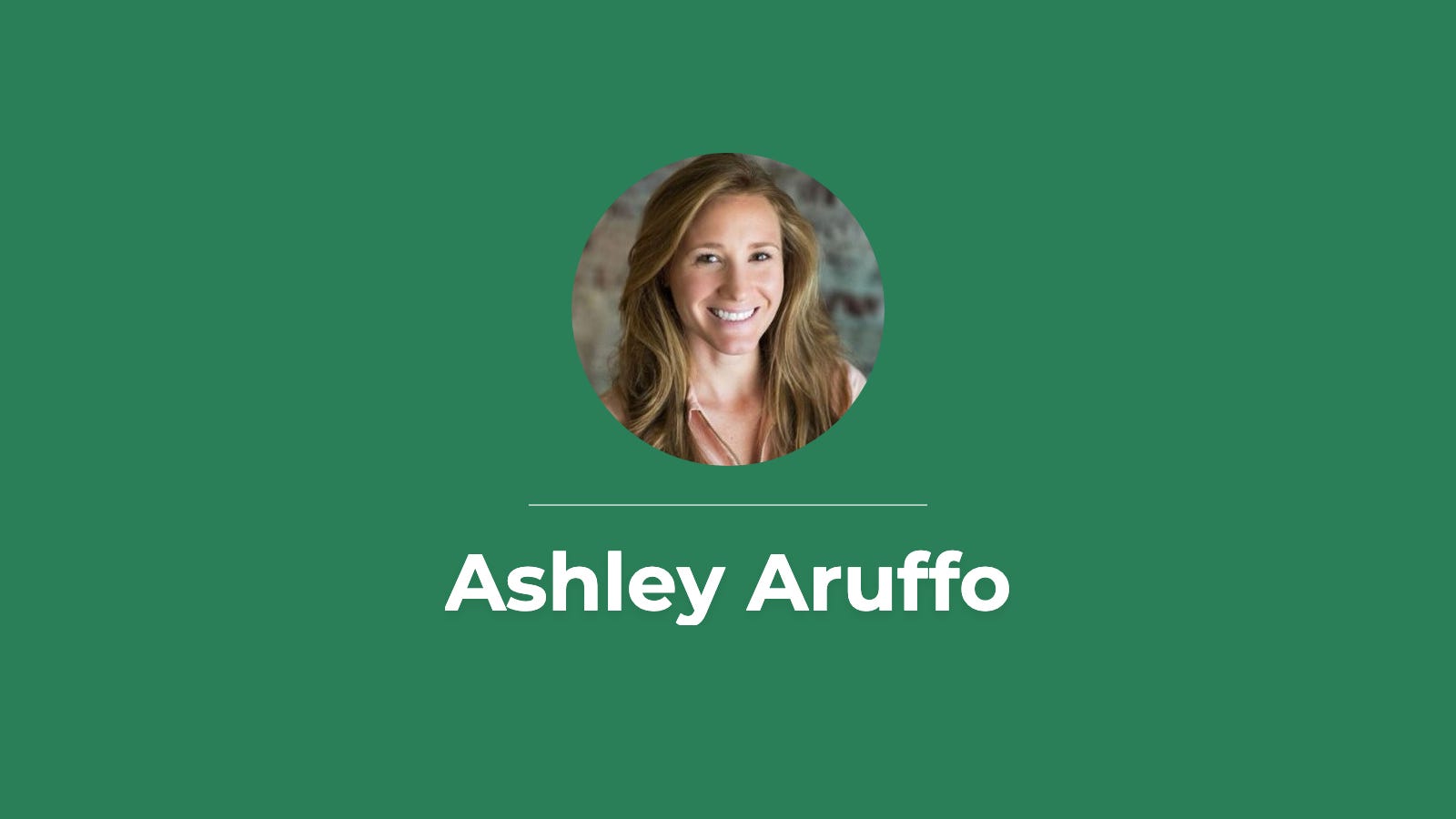
Ashley Aruffo is the VP of Product and Operations at Craft, a San Francisco-headquartered supply chain intelligence company that maps supplier networks and delivers risk insights to procurement professionals, risk analysts, and government agencies. Rising to prominence over five years with the company, she became known for building intelligence products for the defense industrial base, where Craft now works with more than 36 government agencies and resolves over 40 streams of data into a single verified picture of a company. Craft raised a $32 million Series B in February 2023 led by BAM Elevate, with participation from Greycroft, Uncork Capital, High Alpha, ServiceNow Ventures, and Point Field Partners, and holds a five-year, $28 million contract with the Secretary of the Air Force for supplier risk and intelligence technology.
Previously, she served as Division Head of Product, Applied AI at Black Knight, the mortgage technology company that acquired her prior employer. She arrived there through HeavyWater, a Philadelphia machine-learning startup whose AIVA product automated the extraction of income, asset, and insurance information from mortgage documents, and which Black Knight acquired in June 2018. At HeavyWater she confronted the constraint that defines small machine-learning companies: a startup cannot earn the customer trust required to obtain the training samples its models need, a bottleneck the acquisition resolved by handing the team access to an established book of lending clients.
Earlier in her career she worked as a Product Manager at Energage, an employee-engagement software company, after entering product directly out of college and, by her own account, performing every job a startup has to offer. Her work has spanned B2B and B2C products, though she has concentrated on enterprise software built for narrowly defined jobs.
Hey,
Thanks for reading this. I mean that. There’s a lot of content out there competing for your attention, and you spent some of it here. I hope it was worth it. Even better, I hope it prompted you to think about something differently enough that you’d share it with someone who’d get something out of it too.
I started this podcast because tactics never stuck with me. What stuck were stories — business biographies, autobiographies, the decisions people made and why they made them. The principle only clicks once you know the story behind it.
So I built the thing I wanted to listen to. Every week I have two conversations with people who build in technology and product. Then I write the essay in my premium newsletter (Taste Maker) to distill the principles and reflect on the narrative — one that puts you inside the conversation, through my eyes. What caught me off guard. What I kept thinking about after we hung up. Where the principle actually lives once you strip away the jargon.
I make this for myself first. If you read the way I do, you’ll want it too.
PS — If you want to pitch coming on the show, or you know someone I should talk to, shoot me an email at caden@hey.com with "January752" in the subject line so it gets past my filters. I'm not optimizing for famous guests. I'm optimizing for interesting conversations, even from people who aren't LinkedIn influencers.


