

Listen to this episode on Spotify or Apple Podcasts
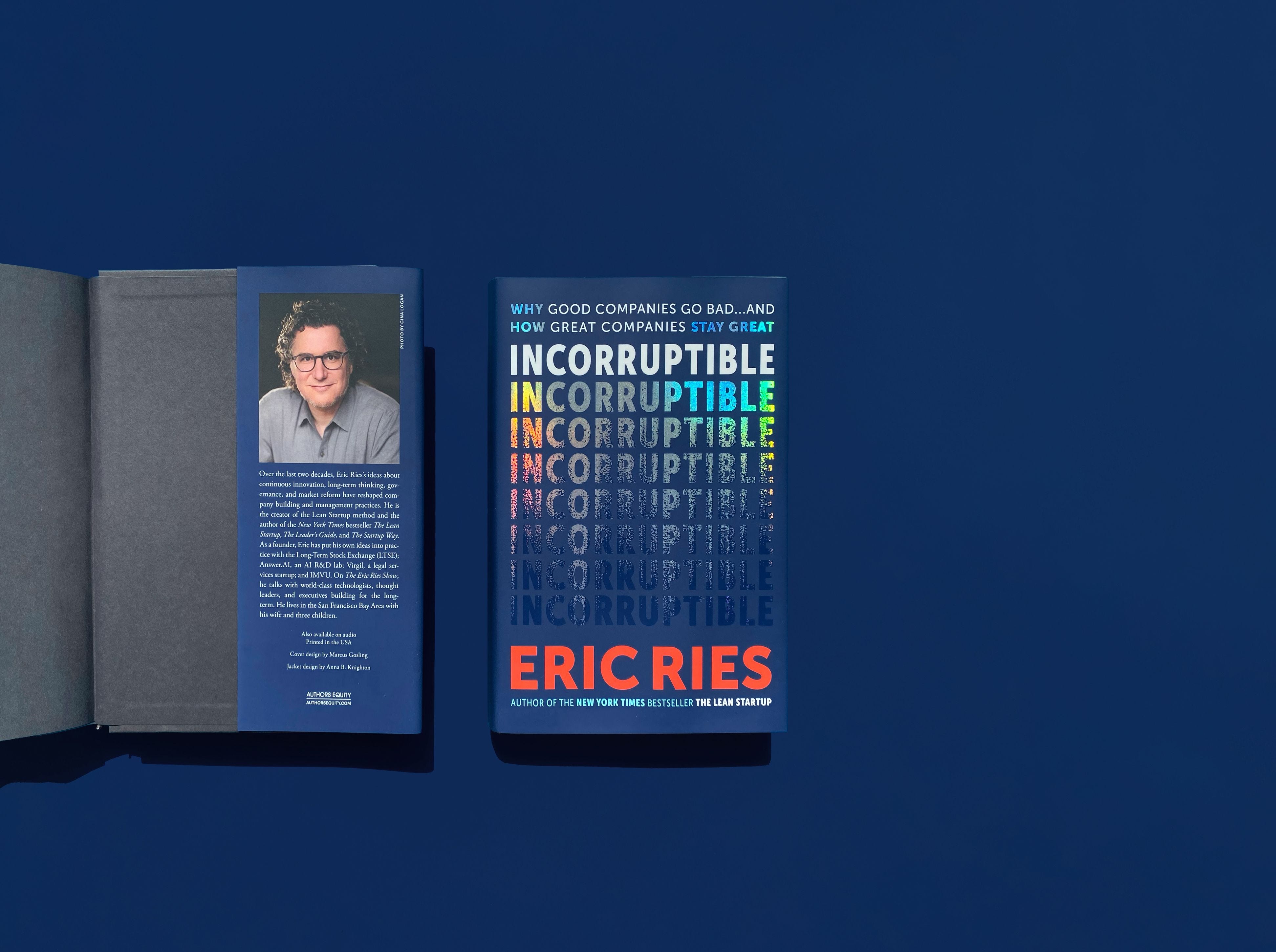
Eric Ries helped invent the playbook a generation of startups used to build fast. Incorruptible is what he learned in the years he spent watching many of those companies become unrecognizable — and the governance structures founders can put in place to prevent it. Your can get your copy here
We’re a few minutes into our conversation when Eric tells me a story about a founder he was advising.
The founder was in earnest. He wanted to know how to bind his company so the technology they were developing, something serious, something medical, would only ever be used to cure people — not kill them. It was the kind of question you ask when you’ve already imagined the version of yourself that wouldn’t ask it.
Eric had been listening. But he had to wrap; he was due at an event in honor of a different founder, a man he’d advised for 10 or 15 years. The young founder was curious. What kind of event?
Eric watched people stream in. A retirement, sort of, he said. Look — there are people at this event who this founder had to fire. They’ve come back to celebrate.
“Mad respect,” the young founder said. “That’s so rare. That’s the kind of company I want to be.”
“You’re not hearing me, man,” Eric said. “This isn’t a party. It’s a wake. He doesn’t work there anymore.”
There’s a beat in Eric’s telling where he says, “He’s like, what?” — and you can hear him reaching for the right way to land what comes next. Because what he had to say was the bridge from one founder’s career to the question he gets asked every week now.
“Yeah,” Eric said. “Even though he made all this money for all his investors, they wanted more, and they ousted him.”
“Is that gonna happen to me someday?” the founder asked.
“Yeah,” Eric said. “That’s what I’ve been trying to tell you this whole conversation. This whole system, by default, unless you take the protective action early — this is what happens to you.”
The founder put it to him this way: Is it possible to build an incorruptible organization?
“Good news, bad news,” Eric said. “Yes. I will tell you how. But you’ve already taken some of the steps in the wrong direction.”
That’s the line that won’t leave me.
Not because it’s clever. Because it inverts every assumption I had about how good companies go bad. I had assumed corruption was a thing that happened to companies later — at some inflection point, after the IPO or the acquisition or the second growth round. That if your founder was good, your culture was strong, and your values were clear, you’d be fine until then. That you could see it coming, the way weather comes from a long way off.
The first chapter of Incorruptible is about Sol Price, who built FedMart and mentored Jim Sinegal of Costco, and who was eventually ousted by his own board, who didn’t want to operate the company the way he wanted to operate it. They wanted to extract value. The system rewarded them for it. What Eric will show you over the rest of the book is that this isn’t a story about one bad board. It is a story about a default state.
Eric Ries has been at the center of the startup movement for 15 years. The Lean Startup made the Minimum Viable Product a household term among the kind of households that have whiteboards in them. He went on to found the Long-Term Stock Exchange, a registered U.S. exchange built for companies that want to opt out of quarterly thinking. A startup law firm. An AI research lab with Jeremy Howard. He has had a particular vantage on the last decade and a half.
“I’ve seen the good,” he tells me. “And I’ve seen the value that’s been created. And I have seen the dark underbelly too. Companies that are being destroyed of their own success.”
He says it the way someone reports something they’ve watched too many times to be surprised by anymore.
He tells me about going to dinner with a group of friends two nights in a row. Two different cities. Both restaurants highly recommended.
First night, the friend who’d picked the place took one bite, set down his fork, and asked the table: “Did private equity take over this restaurant?” Someone pulled out a phone. Yes. The new owners had bought it some months back.
Second night. Different restaurant. Different city. Different recommender. Same first bite. “Is this the same damn private equity firm?” Different firm. Same taste.
“We’ve all had this experience,” Eric says. “Companies that get acquired, that go public, they get bought out — where they just lose that special spark. What made them worth backing and trusting in the first place.”
You can taste it. That is what’s interesting. The thing that’s happened to the company shows up in the food.
The mechanism is what Eric is interested in. Not the symptom. He wants you to understand what changes between the moment a place is good and the moment it isn’t — because the same thing happens at every scale, in every industry, and almost none of the people inside it know it’s happening to them.
To show me how it works, he takes us back to the 1940s. Robert Wood Johnson II, the second-generation owner of Johnson & Johnson, is planning to take the company public during World War II. He’s worried about what that will do to the company over time. So he writes a document, the Johnson & Johnson Credo, that lays out the company’s fiduciary commitments. Patients first. Then doctors and nurses. Then employees. Then communities. Investors last.
The exact opposite of what we now teach as the corporate governance best practice.
He worries people will forget. So he has the credo carved into 10-foot-high limestone blocks and installed in corporate headquarters, where they still stand today. Every person who works there walks past the credo on their way in and on their way out.
For 40 years, executives walked by those blocks. During the same window, the company’s marketing leaned heavily on the credo and MBA case studies held it up as exemplary. Johnson & Johnson also knowingly sold baby powder mixed with cancerous asbestos. And tried to cover it up.
“We know that they tried to cover it up,” Eric says, “because of course these things always come out in litigation. And now we have the internal documents.” A pause. “The same people who put asbestos in the baby powder and tried to cover it up walked by the credo every day.”
The values were carved in stone. The incentives moved. The values lost.
This is where I expect Eric to land on a moral argument. Where he tells me what those executives should have done.
He doesn’t.
He says the executives almost certainly believed they were in compliance with the credo. That they assumed someone at a higher pay grade had worked out how the metrics they were chasing aligned with the values on the wall. That the system they were operating inside had quietly collapsed the distinction between the two.
“This whole modern business philosophy that we’ve all come to live in,” he says, “that puts investors first, that preaches an extraction of value rather than the creation of value — I think that whole way of doing business is corrupt. And I think most founders agree.”
He’s not arguing the executives were bad. He’s arguing they were operating inside a system that produced this outcome by default. The credo was a sign. It was not a structure. And a sign cannot hold a roof up.
The young founder Eric was advising — the one trying to figure out how to make sure his technology only ever cured people — had assumed his good intentions were the structure. That because he meant well, the company would mean well. Eric’s argument, the one that landed so hard, is that this is exactly backward. Good people do not protect organizations from misaligned incentives. They are the ones eaten by them.
The corruption is not a betrayal. It is what the default settings produce.
So when Eric says “you’ve already taken some of the steps in the wrong direction,” he doesn’t mean the founder has done anything wrong. He means the founder has signed a standard incorporation, accepted a standard investor structure, agreed to a standard board composition, and quietly assumed those defaults are neutral. They aren’t. Each of them is a bend in the road. Each of them tilts the company, by a few degrees, toward the wake at the end of the founder’s career.
“Build something worth protecting,” Eric says, “and then actually protect it.”
The corollary is this: there are other defaults available.
Eric tells me about a couple named August and Marie Krogh, who lived in Denmark in the 1920s. August had just won the Nobel Prize. Marie had been diagnosed with diabetes — at the time, a death sentence. They were on a lecture tour of North America when, at one of the dinners, a scientist mentioned to Marie that someone in Canada had figured out how to synthesize insulin.
They went to Canada. They worked out a license to bring the technology back to Denmark.
And then they did something specific. They built the new venture, which they named Nordisk Insulin Lab, as a nonprofit foundation that owned a for-profit subsidiary. A structure called an industrial foundation. They did it because they were worried about pricing power. About what would happen, years from now, if someone realized that a lifesaving drug could become power over the people whose lives depended on it.
That structure is still standing. It’s why Novo Nordisk exists. It is the structure behind Ikea and Hershey, behind several companies you’ve interacted with without realizing the bones underneath were unusual. And here is the part Eric saves for last: companies with this structure are six times more likely to last 50 years than conventionally structured companies.
A founder hears this and asks his lawyer. The lawyer says, oh, no — that’s an old-fashioned thing from Denmark. We don’t do that anymore. We have a much better set of best practices.
Eric, to me, with a small dry smile in his voice: “These advisors may indeed be very smart. But are you sure you’re smarter than a Nobel laureate?”
What I’ve come away with isn’t a list of governance structures. It is a recalibration.
I had been thinking of corruption as a thing companies fell into. A late-stage problem. Something that arrived with the wrong investor, or the wrong CEO, or the wrong acquirer. Eric has me thinking about it the way he thinks about Minimum Viable Products — as something the system produces by default unless you intervene. The intervention isn’t a value statement. It is structural. It is something carved into the company’s bones before the pressure arrives, because once the pressure arrives, there is nothing left to carve into.
This is what the headline means, the one Eric keeps trying to land on the young founder in his office: corruption isn’t the inevitable price of scale. It is a choice you make before you know you’re making it. Every founder who hasn’t architected against it has, by the silence of that omission, chosen it.
Eric ends our conversation the way he ends his book.
“Build something worth protecting. Then actually protect it. So when the pressure comes, when the temptation comes, when the rain comes — the roof is still there.”
That’s the line I keep coming back to. Not the credo on the wall, not the values in the deck, not the founder’s intentions — the roof.
Guest Bio: Eric Ries
Eric Ries is the author of The Lean Startup (2011), The Startup Way (2017), and Incorruptible: Why Good Companies Go Bad, and How Great Companies Stay Great (May 26, 2026). The Lean Startup — which introduced the Build-Measure-Learn feedback loop and the concept of the Minimum Viable Product — has been translated into nearly 30 languages, became required reading at Y Combinator, and established the dominant framework for product development and entrepreneurship for the better part of fifteen years. Ries co-founded IMVU, the social avatar platform, in 2004 with Will Harvey, where he first developed and applied the customer development practices that would later become the methodology.
In 2011, Ries outlined the idea for a fundamentally different kind of stock exchange inside The Lean Startup. He spent the better part of a decade making it real: the Long-Term Stock Exchange (LTSE) received SEC approval as a national exchange in 2019 and launched trading in September 2020, designed expressly for companies committed to long-term value creation over short-term shareholder extraction. He has since co-founded Answer.ai with Jeremy Howard of fast.ai — an AI research lab focused on practical applications — and founded Virgil, a startup law firm designed around founder needs rather than billable hours.
Incorruptible draws on more than 200 years of case studies — from Johnson & Johnson and Costco to Novo Nordisk and Ikea — to argue that the governance structures most companies adopt by default are engineered to destroy the values that made them worth building. Ries’s thesis: companies that last aren’t those with better culture decks, but those whose founders protected the organizational structure before they lost control of it.

Hey,
Thanks for reading this. I mean that. There's a lot of content out there competing for your attention, and you spent some of it here. I hope it was worth it. Even better, I hope it prompted you to think about something differently enough that you'd share it with someone who'd get something out of it too.
I started this podcast because tactics never stuck with me. What stuck were stories — business biographies, autobiographies, the decisions people made and why they made them. The principle only clicks once you know the story behind it.
So I built the thing I wanted to read. Every week I have two conversations with people who build in technology and product. Then I write the essay I wish I could find — one that puts you inside the conversation, through my eyes. What caught me off guard. What I kept thinking about after we hung up. Where the principle actually lives once you strip away the jargon.
I make this for myself first. If you read the way I do, you’ll want it too.
PS — If you want to pitch coming on the show, or you know someone I should talk to, shoot me an email at caden@hey.com with "January752" in the subject line so it gets past my filters. I'm not optimizing for famous guests. I'm optimizing for interesting conversations, even from people who aren't LinkedIn influencers.


