

Listen to this episode on Spotify or Apple Podcasts
Chris Pearcey keeps coming back to a number.
“There’s 250,000 titles,” he says, “but nothing to watch.”
He uses it as the hook for his investor pitch. He uses it on me, in our first ten minutes of conversation. It’s the kind of line that is at once obviously true and obviously unsatisfying. You can feel the dissonance. A quarter-million pieces of professionally produced entertainment, sitting one tap away on a phone, and the average person opens the streaming app and feels paralyzed.
“And that’s by design,” Chris says.
That’s the part I don’t expect. I expect the lament. I don’t expect the by design.
Chris is the founder and CEO of Deci Media, makers of Decisio — Latin root of decision, plus .media. The app is free, ad-free, and built around what he calls a patent-pending four-way swipe system. It launched January 1st of this year and has added more than five thousand users since, almost entirely through Google Ads. He’s based in Beaverton, Oregon. He spent ten years on the data engineering side of the business and ten years on the product side — including five at Nike, where he was the advanced analytics product manager for planning tools across Asia and Latin America, and where his job was to drag forecast accuracy from sixty-five percent to above ninety. His team got it to ninety-three in six seasons.
He wears the data engineer pretty visibly. Within the first ten minutes of our conversation, he tells me that he started the Decisio platform by trying to use AI for the data curation step. He had to pull movies and shows and metadata from the top ten streaming platforms — every title, every distribution status, all of it — into his own database. He fed the job to AI.
“I was getting 40% false positives,” he says.
Forty percent of the records were wrong. Titles that weren’t on the platform, returned as available. Titles that were available, returned as missing. Forty percent.
“It’s only as good as the information it gets,” Chris says. “We’re not even past the foundations period. But some people wanna put the roof on already.”
He goes back to a metaphor I now hear him use three different times.
“AI right now is like a first year medical student,” he says. “And I think many people are ready to give on the keys of the hospital already.”
He builds an actual ETL pipeline. Old-style data engineering. Extract, transform, load. He pays a monthly fee for a real database API. The pipeline is deterministic, repeatable, a hundred percent accurate. The AI does not get the keys to this part of the hospital.
He used AI to help write the pipeline. “It probably would’ve taken me weeks to build these pipelines out that I got. I was able to build it in an hour because of AI.” The first-year medical student is a useful assistant. He just doesn’t get to run the surgery.
The reason any of this matters, in Chris’s framing, is that the streaming industry’s data problem isn’t a data problem.
I bait this out. “And you’re claiming that’s a data problem?”
“I absolutely —” he starts. Then he stops. “Ab, well,… It’s a purposeful data problem.”
He’s choosing his words.
“They want to overwhelm you,” he says. “When you go, when you log into Netflix, you don’t want to search. You just look at what the top 10 movies are and then you —” he mimes the click — “and all 10 of those movies make Netflix a boatload of money. But your satisfaction is probably not gonna be the greatest when you’re done with the movie. But yet it’s still in the top 10 every time.”
This is the thesis. Two hundred fifty thousand titles is not an artifact of abundance. It is a feature. The catalog is engineered to be too large to navigate, because a user who feels overwhelmed will accept the algorithmic top-ten. The top-ten is where the platform’s economics are best. Your dissatisfaction is irrelevant; you watched it, you didn’t cancel, the metric clears.
He cites a stat I have to ask him to repeat. The average person spends eighteen minutes searching for something to watch or read. Thirty-three percent give up. Of the people who do find something, eighty percent take the algorithm’s recommendation, and fifty percent are dissatisfied with what they ended up watching.
A third of the audience walks away. Half of the surviving viewers feel cheated by the recommendation. And the catalog keeps growing.
“They’re incentivized to push that they profit on,” Chris says.
He doesn’t say they with venom. He says it with the matter-of-factness of someone who used to build advanced analytics for Asia-Pacific apparel forecasting and now understands exactly how to build a system that optimizes for the wrong outcome on purpose.
What happens next is the part of the conversation where I start to see the shape of what he’s actually doing with Decisio.
It is not a recommendation engine. Or — it is, but the recommendation is not the product. The product is intent capture.
“No one’s capturing intent,” Chris says. “You know, there’s no way for AI to capture intent, or any of these sites. So I also wanted to do something where we can capture intent, because if a thousand people wanna see a new release, 9,000 don’t, I mean, that’s that Megan 2.0 last summer. That’s a perfect example.”
I watch him connect the dots in real time. Megan 2.0 was the sequel nobody asked for. The first film hit. The studio assumed the audience for the first film would translate to the audience for the second. The audience never showed up. Nobody had captured the don’t. The data they had said people liked Megan. The data they didn’t have said people did not, in fact, want a Megan 2.0.
Negative intent is a missing primary key.
“AI starting to understand what we like,” Chris says. “I don’t think it understands what we have no interest in. And that’s the key differentiator that I’m trying to also create.”
The four-way swipe is the mechanism. Left and right are the familiar Tinder gestures — like and dislike. Up and down are the move he claims as patent-pending. Up: I want to see this. Down: I do not want to see this.
Two pieces of data per card become four. Fifty swipes in about three minutes — he times it — and the system has enough signal to surface a recommendation that isn’t generic.
“You’re not getting stuck. You’re not seeing things that are outside of what you’re looking for,” he says. “You’re seeing only content. To see if you’re interested or not, or if you’ve seen it or haven’t.”
The reason this matters — and the reason it isn’t just a product decision — is that the four-way swipe is the cheapest possible way to extract negative preference from a user without making them write a sentence. Ask people to type what they don’t like and most of them will type nothing. Show them a card and ask them to swipe down and they’ll tell you, in three minutes, fifty things they have no interest in.
That signal is what every recommendation engine on the internet is missing. Netflix knows what you watched. Your algorithm knows what you liked. Neither one captures what you would actively pay to never see again.
The other detail Chris is proud of, in that quiet engineer-founder way, is the analog feel.
The cards in Decisio flip. Movies and shows present like an old VHS box. Books flip like, well, books — front cover, page-edge, back cover. The card is a deliberate visual artifact from the rental-store era.
“Especially the, the Gen X millennial folks,” Chris says, “they said, this feels like the, you know, it’s nice to have something that feels physical again in my hand.”
He smiles a bit, in that quick way he has when he’s pleased with the data. The Gen Z group is more telling.
“Gen Z in particular right now is, uh, someone said that the app feels very analog, but they love that because they are not ready for it. They’ve never had a life without AI right now, you know, in their minds.”
Read that back slowly. They’ve never had a life without AI. The cohort he’s talking about is asking for the swipe and the VHS box because the swipe and the VHS box do not require them to outsource their taste to a model that already knows too much about them.
The whole product is, in a sense, a refusal. A refusal of the algorithmic top-ten. A refusal of the chatbot recommendation. A refusal of the doomscroll. The four-way swipe is the answer to what Decisio’s users — including, he says, himself — actually want from a recommendation engine: a tool. Not a feed.
“What I’m excited about software right now,” I say to him at one point, “is that it’s a tool that you use. It’s actually a tool. It’s not some engagement slot machine anymore. It’s a — I will pay a hundred dollars a month to pick this up and put it down.”
Chris doesn’t even pause. “Yes.”
The cheaper the tool, the more engaging it has to be. The more expensive the tool, the more it has to respect the user’s time. Decisio is free. But the design philosophy belongs to the expensive-tool category. It is built to be picked up, used, and put down.
Toward the end, Chris tells me the metric he tracks for himself.
“I use the app regularly,” he says. “Right now I’m at 63 of 64 loves on the recommendations.”
Sixty-three out of sixty-four. He’s the customer. He’s the one keeping score.
“It’s never gonna be a hundred percent, we know that, but still, I’m shooting at about, you know, 98% right now. And that to me tells me that I’ve now taken a lot of my time back.”
Sixty-three out of sixty-four. The four-way swipe didn’t try to know him better than he knows himself. It just gave him a fast way to tell it what he didn’t want, and an even faster way to tell it what he did. Fifty swipes. Three minutes. Sixty-three out of sixty-four loves.
That’s not an AI breakthrough. That’s a UX bet. The bet is that the user is the algorithm. The bet is that the platform’s job is to listen, fast and structured, and then get out of the way.
I keep returning to the by design framing.
The 250,000 titles is by design. The eighteen-minute search is by design. The fifty percent dissatisfaction is by design. The streaming industry built a data problem on purpose because a confused user is a profitable user.
Decisio is also by design. The four-way swipe is by design. The VHS box flip is by design. The free tier and the no-ads are by design. So is the part that makes me think Chris is going to win this — the choice to capture negative intent, the choice to ask the user what they do not want.
The cynical version of this story is that one set of designers built an overwhelm engine to maximize platform revenue, and another set of designers is now building an intent engine to maximize user satisfaction. The fight is asymmetric. Netflix has decades of compounding capital and a fixed top-ten. Decisio has five thousand users and a four-way swipe.
The hopeful version of this story is the one Chris keeps coming back to without quite saying.
Some products are built to keep you on the phone. Some products are built to get you off the phone, into the chair, into the book, into the movie. Those two categories are running in opposite directions. The market still has not decided which one it values. But the people who are sick of the slot machine — and Chris is convinced there are a lot of them — are quietly looking for the tool.
Sixty-three out of sixty-four says they might find it.
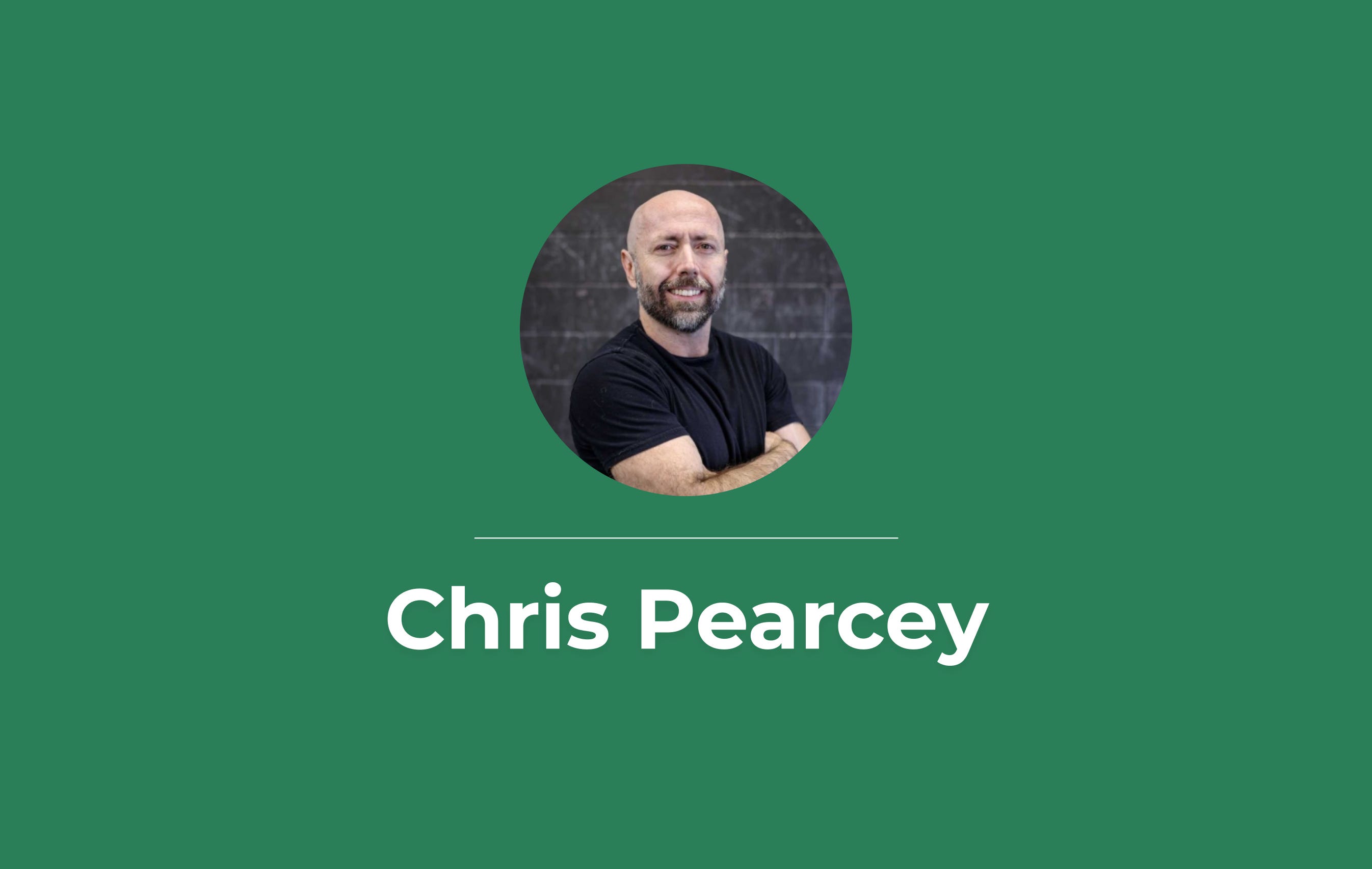
Guest Bio: Chris Pearcey
Chris Pearcey is the Founder and CEO of Decisio.media, the company behind Decisio, a free, ad-free entertainment recommendation app built around a patent-pending four-way swipe system that captures positive and negative viewing intent across movies, television shows, and books. Rising to prominence in the mid-2010s as a data engineering and analytics leader in enterprise product organizations, he became known for applying machine learning to forecast accuracy problems at scale inside some of the world’s largest consumer brands. Since launching Decisio on January 1, 2026, the app has grown to more than 5,000 users on minimal marketing spend, acquiring customers exclusively through Google Ads.
Previously, as Advanced Analytics Product Manager at Nike, he supported planning tools for the Asia and Latin America regions and drove forecast accuracy from 65% to 93% over six seasons by introducing consumer profile modeling — one of the more precisely measured single-initiative improvements in Nike’s planning systems during that period. He also held product and engineering roles at Amazon Web Services before founding Deci Media, building the enterprise-scale data infrastructure background that informs Decisio’s deterministic recommendation architecture.
His career highlights span 20 years split evenly between two disciplines: 10 years as a database engineer specializing in machine learning and advanced analytics, followed by 10 years in product management across enterprise software organizations. Headquartered in Beaverton, Oregon, Deci Media is built on the conviction that streaming platforms’ 33% abandonment rate and 50% viewer dissatisfaction rate are not failures of recommendation algorithms — they are the predictable result of platforms optimized for engagement metrics rather than viewer satisfaction.
Hey,
Thanks for reading this. I mean that. There's a lot of content out there competing for your attention, and you spent some of it here. I hope it was worth it. Even better, I hope it prompted you to think about something differently enough that you'd share it with someone who'd get something out of it too.
I started this podcast because tactics never stuck with me. What stuck were stories — business biographies, autobiographies, the decisions people made and why they made them. The principle only clicks once you know the story behind it.
So I built the thing I wanted to read. Every week I have two conversations with people who build in technology and product. Then I write the essay I wish I could find — one that puts you inside the conversation, through my eyes. What caught me off guard. What I kept thinking about after we hung up. Where the principle actually lives once you strip away the jargon.
I make this for myself first. If you read the way I do, you’ll want it too.
PS — If you want to pitch coming on the show, or you know someone I should talk to, shoot me an email at caden@hey.com with "January752" in the subject line so it gets past my filters. I'm not optimizing for famous guests. I'm optimizing for interesting conversations, even from people who aren't LinkedIn influencers.


