Listen to this episode on Spotify or Apple Podcasts
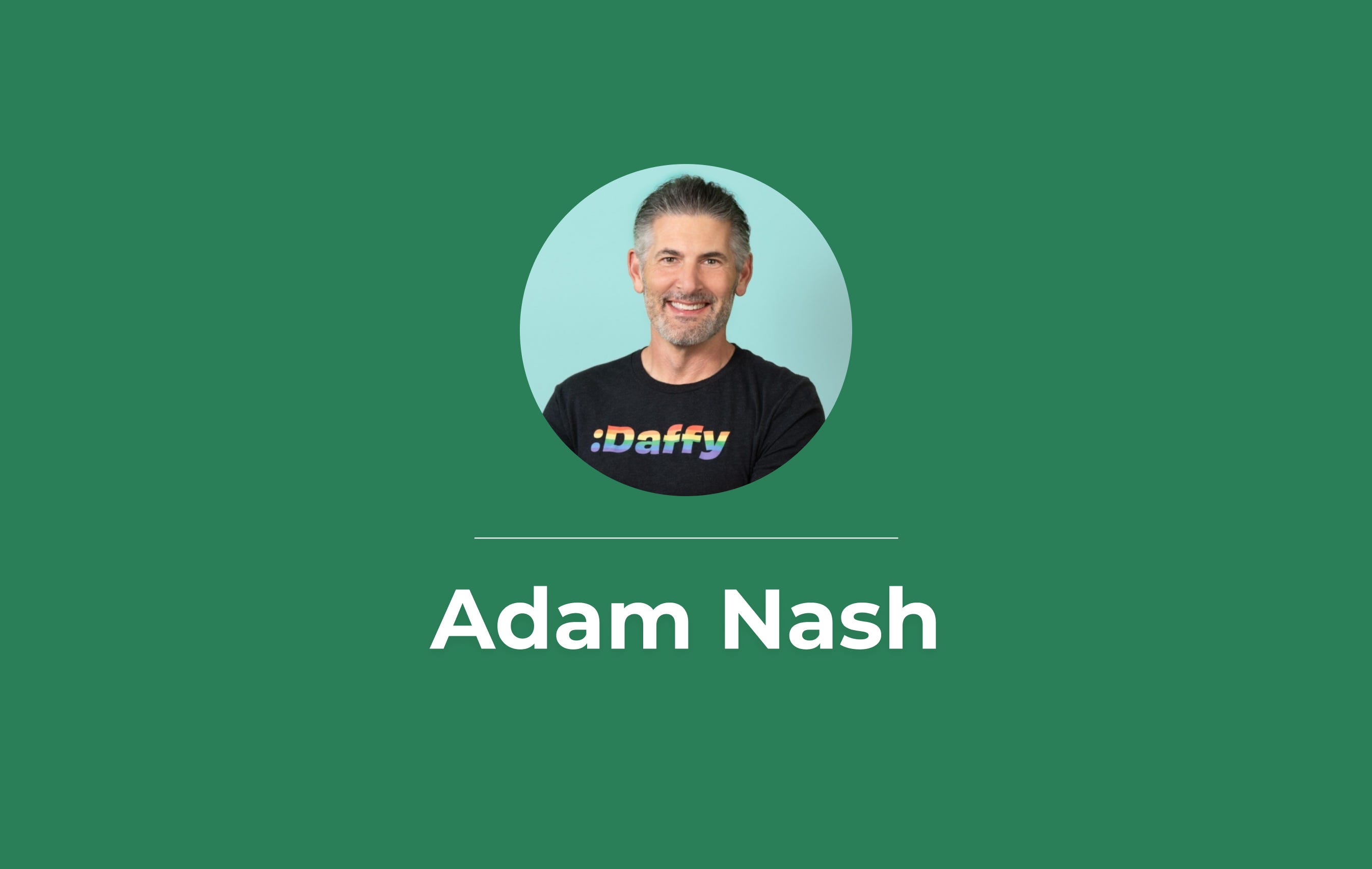
Adam Nash holds degrees in computer science with a focus on human-computer interaction, an MBA from Harvard, and has spent 25 years working at the overlap of engineering, design, and finance. His read: the best product work isn’t about solving rational problems — it’s about designing around the ways humans reliably behave irrationally. He built that argument across eBay, LinkedIn, Wealthfront, and now Daffy — where every feature exists to close the gap between what people want to do and what they actually do.
About forty minutes into our conversation, Adam Nash confesses something I believe to be the crux of our conversation.
“The anxiety I have alone — still, I don’t know how it is — I am almost 50 years old,” he says, “my anxiety in a hotel room of accidentally moving one of those items in the minibar and being charged for it is not rational. But it’s somehow very deep-seated.”
I almost laugh. Not at him — with him. Because Adam Nash is, by any reasonable measure, the person you’d least expect to be intimidated by a hotel minibar. He teaches a Stanford class called Personal Finance for Engineers. He ran Wealthfront. He was VP of Product at LinkedIn through the IPO. He was CEO of a fintech company that managed billions of dollars on behalf of its customers. If anyone on Earth should be able to glance at a $9 Toblerone and shrug, it’s him.
Instead, he tells me he gets nervous about it. And the way he tells me is what I keep thinking about. He doesn’t dress it up. He doesn’t make it a metaphor first and a confession second. He says it the way you’d admit to a friend at a bar that you still get butterflies before flying. The point isn’t that minibar anxiety is interesting. The point is that even Adam — the guy who has designed financial products for two decades — still has it. And that’s the entire thesis of his career.
We’ve been talking about Daffy, the company he founded in 2020. Daffy stands for the Donor Advised Fund For You, and it’s exactly what it sounds like: a tax-advantaged account for charitable giving. You put money in. It invests tax-free. Whenever you’re inspired to give, you go in, pick a charity, send the money. The wealthy have had access to this product for decades — Fidelity, Schwab, and Vanguard all offer one — but most people have never heard of it.
That gap, Adam tells me, is the entire opportunity. And the gap exists not because the math is hard, but because of something much stranger: people are not rational about money. Especially their own.
“Money is very rational,” he tells me. “Dollars and cents, right? You know, the math adds up. Like it’s either a good return or a bad return.” He says it the way someone reads aloud from a textbook they don’t fully agree with. Then he pivots. “But in the end, what’s the money for gets back to people — and people have feelings about money. They have feelings about what they’re doing with it, how they earned it, how they spend it, et cetera.”
This is the move that runs through everything he’s built. He stages the rational view first — the one MBAs are trained on, the one accountants live inside — and then he pulls it apart. Not because the rational view is wrong. Because it’s incomplete in the only way that matters: it doesn’t account for the actual humans who use the product.
I ask him how that lens — the irrationality lens — got into his work. He goes back to the early days of his career, when design was treated, in his words, “as almost an accessory marketing function — like make it pretty. Um, oh, make sure the brand is correct, the colors and text.” He’s not bitter about it, but you can hear something in the cadence — a person who watched an entire discipline be miscategorized for years and decided, at some point, to fix it where he could.
When he got to LinkedIn, he sat down with Reid Hoffman and made an argument that the company needed a horizontal design team — a team whose responsibility was the end-to-end experience, not any single page or feature. He’d spent his eBay years watching Web 1.0 products turn into “a library of pages and not really a product, not really an experience.” He didn’t want LinkedIn to become that. The team he built is still there.
But the more interesting story, to me, is what happened earlier. The career detail he drops almost as a footnote.
“I actually started,” he says, “I thought I was interviewing at a company called NeXT, but it turns out Apple acquired them in the middle. So I was there when Steve came back.”
He says this the way some people mention their college roommate. He worked on Rhapsody, which became Mac OS 10, which became the operating system most of us spent the next two decades using. He was there for the moment when Steve Jobs walked back into Apple and the entire trajectory of consumer computing changed. He’s not bragging. He’s setting up a different point. The Apple culture he watched — and later the Pixar culture he studied through Ed Catmull’s Creativity, Inc. — taught him that great products are made when designers, engineers, and operators don’t fight each other for primacy. They take each other’s instincts seriously.
“If they came up with an idea, there must be a good reason for it,” he says, paraphrasing the Pixar engineering team’s posture toward design. “Let’s figure out how to make that real and make that as excellent as possible.” And vice versa. It’s the win-win posture, he says, that makes a team transcend its parts.
I’ve worked at companies where this happens and at companies where it doesn’t, and the difference is night and day. He doesn’t romanticize it. He’s quick to point out the failure mode. “There’s a hubris that can set in with different roles,” he tells me, “where people decide that — no, engineering is the most important role, we can’t do this without it. Design is the most important role. And of course, product folks — product is the most important role.” He pauses, like he’s actually testing the claim against his own memory. “I think it misses the big picture.”
The big picture, in Adam’s telling, is that no one function ever shipped anything beautiful by itself. Beautiful products require people who can hold multiple frames at once. And the highest-value frame, in his career, has been the one that takes irrationality seriously.
I want to know how that frame translated into Daffy. So I ask him about a feature I noticed — the auto-deposit. You can have money debited from your account every week, every month, into your Daffy fund, before you ever decide where to give it. To me, that’s the whole product. You’ve already mentally separated the money from your life. By the time you sit down to give, the friction is gone.
He nods. This is the move he’s most proud of, I can tell, because his whole tone shifts. He starts using the word “we” more — the team voice. And he starts walking me through what he calls the most important insight of the company.
“Giving involves not one, but two hard problems for most people,” he says. “One is how much can I afford to give? And two, who do I give the money to? And the worst thing about the transactional system that we currently have is that you get hit with both of those problems.”
I have to stop and write this down, because it’s the cleanest articulation of a pattern I’ve watched fail thousands of people in dozens of contexts. Every donation page on the internet asks you both questions at the same time. Pick a charity. Pick an amount. Right now. Most people stall on one or the other and end up doing nothing. Or they default to the easiest option — give five dollars to a friend’s GoFundMe — and feel vaguely guilty that this isn’t what they meant by “I want to be generous.”
Adam tells me about the customer research he did before founding Daffy. He went around the country, talking to people about their giving. The thing that struck him wasn’t the diversity of opinions — though there was plenty of that. It was the consistency of one specific moment.
“You ask them how much they think they should give to charity every year — most people have an idea of what that is. But you ask them, did they hit their goal? And they all end up with this pregnant pause of no, you know, life got in the way, it got busy.”
The pregnant pause. He says it like he heard it dozens of times and stopped being able to un-hear it. Everyone had a number. Almost no one hit it. And the gap between intention and action — what he calls the Generosity Gap — wasn’t a values problem. It was a design problem.
This is the moment in our conversation when I realize what he’s actually doing at Daffy. He’s not trying to convince anyone to give more. He’s trying to remove the design friction that keeps generous people from acting on their own intent. The same way a 401(k) doesn’t make you save more — it just removes the moment of decision that you would otherwise fail at.
“It turns out with money, with finance, automating these things gets you to your goal more reliably and faster,” he says. “If we can do this with saving and investing, why can’t we do this with giving?”
He keeps coming back to this. The rational thing — the thing the textbook would say — is that adults should be able to set a giving goal and meet it through willpower. But adults can’t. And not because they’re bad. Because the system is built against them.
We get into the part of his thinking that he wrote about more than a decade ago, in an essay he called Finding the Heat. He tells me about being in marketing meetings where everyone wanted to talk about the brand’s positive attributes — hope, security, control. He’d push back. “We look at half the problem,” he tells me. “The world isn’t just filled with positive feelings.”
The negative emotions matter just as much. Maybe more. Fear. Anxiety. Embarrassment. The fear of messing something up. The fear of being charged for the minibar item you didn’t actually take. He’s not being cute when he tells me this — he’s giving me the same example he probably gave a marketing team a decade ago. Money has heat. If you design as if it doesn’t, you’re missing the actual problem.
And this is the place where his framework finally lands for me. Designers, when they’re doing the job at full strength, are behavioral economists. They’re not arranging pixels. They’re studying the predictable ways humans fail to do what they say they want to do — and then designing around it. The button isn’t bigger because bigger is prettier. The button is bigger because there’s a moment of doubt that you have to walk the user through. The default is opt-in because the literature on defaults is conclusive. The deposit happens before the decision because the research on pre-commitment is overwhelming.
Adam doesn’t say it this way. He doesn’t have to. The whole conversation is the proof.
I bring up Rory Sutherland — the Ogilvy executive who’s spent his career arguing that most things fail because we apply rational solutions to emotional problems. Adam smiles at the framing. He partly agrees. But he wants to add a wrinkle.
“I don’t know if you’ve met rational humans,” he says. “Please let me know. I know there are 8 billion on the planet. I’ve not met all.” He’s joking, but the joke has teeth. The framing of “rational vs. emotional” is itself a category error. There aren’t two camps. There’s one camp — humans — and they all have feelings about money, even when they’re trying not to. Even Adam. Even in a hotel.
We talk about Daffy Campaigns, the feature that lets members fundraise for causes and offer matching donations. He tells me about a member whose parent — a teacher — had passed away two decades earlier. On the anniversary of the death, the member ran a campaign to raise money for students. “That kind of story is not going to come out of a marketing team,” Adam tells me. “That kind of story is not going to come out of a corporate kind of process. These are personal stories that people are telling.”
He says it quietly. We’ve been talking for over an hour and the energy in his voice has settled into something I’d call admiration — for the people using the product more than for the product itself. He keeps saying “we” when he talks about Daffy, but when he talks about the campaigns, he says “they.” The members. The givers. The teacher’s child. The company is the scaffolding. The campaigns are the building.
I ask him to wrap things up however he wants. He doesn’t pitch. He doesn’t ask anyone to download anything. He says one thing that I’ll keep returning to.
“It really does feel good,” he tells me, “to realize that some of the benefit of your skill, of your work, of your life, could benefit others.”
Then, almost as an afterthought, he tells me what people say after they’ve used the product for a while. It’s not that they saved money on taxes. It’s not that the interface was nice. It’s that the product made them feel good about how they were teaching the next generation.
Which is, I realize after we sign off, the most behavioral-economics thing he could have told me. The product’s measurable outputs — dollars donated, accounts opened, charities funded — are not what closes the loop with the user. The feeling does. The story they tell themselves about who they are when they use it. The image of their kid asking what the donation is for, and them having an answer.
That’s the gap that was always there. Adam built a product that closed it. And the only reason he could see the gap in the first place is that he never bought the premise that designers are decorators. He understood, going back to NeXT and Steve Jobs and Reid Hoffman and the Generosity Gap, that designing for humans is the same job as designing around their irrationality.
Giving isn’t a values problem, it’s a tooling problem.
When it’s a tooling problem — it’s a design problem.
About Adam Nash
Adam Nash is the Co-Founder and CEO of Daffy, a donor-advised fund platform revolutionizing charitable giving. Rising to prominence in the 2010s as a product leader across Silicon Valley’s most influential technology companies, Nash became known for scaling platforms to hundreds of millions of users and pioneering new categories in fintech.
Previously, as Vice President of Product & Growth at Dropbox from 2018 to 2020, Nash led the teams responsible for growth, product strategy, product management, and product analytics for a platform serving over 600 million registered users with responsibility for approximately 90% of all company revenue in 2019. Before Dropbox, he served as President and CEO of Wealthfront from January 2014 to October 2016, where he championed the creation of automated investment services and grew the company’s client base by over 60x while scaling assets under management 45x from less than $100 million to over $4 billion.
His career highlights include serving as Vice President of Product Management at LinkedIn, where he led the company’s Platform & Mobile products including the launch of LinkedIn’s open developer platform and native applications. Nash founded LinkedIn Hackdays, a program instrumental in driving the company’s innovation culture, and led search, cloud efforts, and user experience design teams. Earlier in his career, he held strategic and technical roles at eBay and Apple.
As an angel investor since 2011, Nash has invested in over 150 seed-stage companies including Figma, Gusto, Opendoor, Firebase (acquired by Google), and Boom Supersonic. He has served as an Adjunct Lecturer at Stanford University since 2017, teaching CS 007: “Personal Finance for Engineers.” Nash holds BS and MS degrees in Computer Science from Stanford University and an MBA from Harvard Business School.
Hey,
Thanks for reading this. I mean that. There's a lot of content out there competing for your attention, and you spent some of it here. I hope it was worth it. Even better, I hope it prompted you to think about something differently enough that you'd share it with someone who'd get something out of it too.
I started this podcast because tactics never stuck with me. What stuck were stories — business biographies, autobiographies, the decisions people made and why they made them. The principle only clicks once you know the story behind it.
So I built the thing I wanted to read. Every week I have two conversations with people who build in technology and product. Then I write the essay I wish I could find — one that puts you inside the conversation, through my eyes. What caught me off guard. What I kept thinking about after we hung up. Where the principle actually lives once you strip away the jargon.
I make this for myself first. If you read the way I do, you’ll want it too.
PS — If you want to pitch coming on the show, or you know someone I should talk to, shoot me an email at caden@hey.com with "January752" in the subject line so it gets past my filters. I'm not optimizing for famous guests. I'm optimizing for interesting conversations, even from people who aren't LinkedIn influencers.