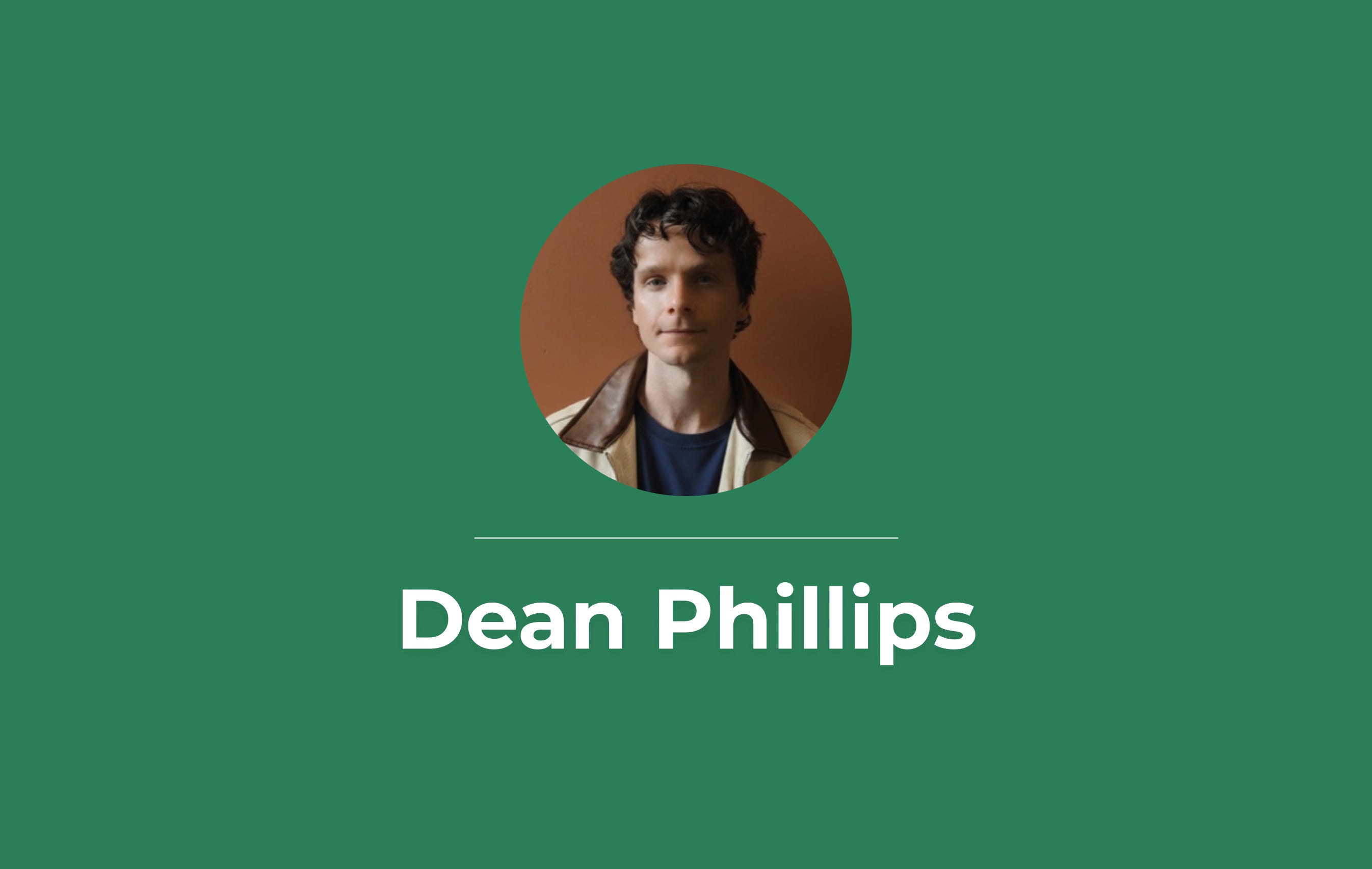
Listen to this episode on Spotify or Apple Podcasts
Dean Phillips wasn’t a product manager — he was a ClickUp power user who got tired of waiting for someone else to fix the Docs product. He built a 25-slide deck, emailed CEO Zeb Evans, and essentially said: you should build this. Zeb’s reply was a job offer. Five years later, Dean has overseen every major ClickUp product launch without a single direct report.
It’s early 2019. Dean Phillips just been hired at ClickUp. There’s no onboarding. There’s no playbook. The company is post–Series A but small enough that the entire product organization fits in a Zoom call. Zeb Evans, the CEO, has dropped Dean into the Docs backlog and told him, more or less, to figure it out.
So Dean opens the task tracker. There are 150 ideas in there.
“I literally just went through,” he tells me. “I remember it was just like a week and hours and hours and hours of me just going through each task and reading the descriptions.”
He’s narrating this with the specific energy of someone telling a story they’ve never quite told this way before. He’s not bragging. He’s reconstructing. And then he gets to the part that, when he says it, almost makes him laugh.
“And actually finding many of the ones that I had actually written and suggested to them. You know, saying like — this Dean guy suggests this — really good idea.”
I have to ask him to repeat it. Because that’s the whole story, right there, compressed into a single recursive moment. Dean Phillips, day one of his first product job, reading through the Docs backlog and finding his own ideas in the tickets. Not because he was already an employee. Because for two years before he was hired, he’d been so active in the ClickUp community — in the company’s idea board, in the Facebook group, in DMs with the team — that the actual employees had been writing his suggestions down in their own backlog and citing him by name.
He was already in the room before he was in the room. He just hadn’t noticed.
Dean’s official job title these days is Head of Product Strategy at ClickUp. He’s based in Manchester, UK. He works alongside Zeb Evans on the strategy of every product area in the company — Docs, Tasks, Dashboards, Chat, AI. He has no direct reports. By choice. He’s a super IC, in his words. And every major product launch ClickUp has shipped over the last five years has been led by him.
What I want to know, when I get him on the call, is how this happened. Because the cold email story is the thing everyone notices — Dean built a 25-slide deck about ClickUp’s Docs product, sent it to Zeb without permission, and got hired off the back of it. That’s the story you tell at parties. That’s the LinkedIn post. But the cold email is not the actually interesting part.
The actually interesting part is what made the cold email possible.
I ask him about the email. He tells me what’s already half-public — that he wasn’t a product manager, that he didn’t even know product management was a job. He’d run a design agency. He’d been a CTO at an educational company. He’d consulted for WordPress plugin companies. He’d built websites with Adobe Muse, which I make him laugh about because I also used Muse and I had also forgotten Adobe ever made it. None of that work was called “product.” It was called freelancing. He had no title for what he was doing.
But he kept doing it. And he was a heavy ClickUp user — the kind of user who lives in your idea board and tells you what’s wrong with your roadmap. So one day he just sat down and made the deck.
“I actually put together this giant deck,” he tells me, “which was all about how I could see their docs product essentially coming together and all the gaps in the market and everything, and this was purely just from a user’s perspective.”
He sent it. Then, because he’s the kind of person who doesn’t quite trust his own initiative, he basically apologized for it.
“I was like — you should execute this. Please do this.” He pauses, almost embarrassed. “Essentially begging them to do it.”
The response was not what he expected.
“This is amazing. Do you want to come and execute it with us?”
He says it the way you’d describe a punchline you didn’t know you were setting up. Then he gets to the part that I think is more honest than the cold-email mythology gives credit for.
“I was really, really surprised, you know, when I got that,” he says. “Because as I mentioned, I didn’t even know that was something you could do.”
This is what gets me. The lore of the cold email always assumes that the sender knew what they were doing — that the strategy was the email, that the slide deck was a cover for ambition. With Dean, it wasn’t. He didn’t think product management was a real role. He thought he was a fan with too much free time and too many opinions about a productivity tool. The deck wasn’t a job application. The deck was the work he wanted to see done, made tangible. Zeb just happened to recognize what it was.
That’s the thing about cold emails that nobody talks about. They don’t work because they’re cold. They work because the sender has done the work first. The work has to exist before the relationship does. You can’t fake the deck.
When Dean joined, the job description was vague — there was no job description — and the support structure was approximately zero. “There was no, like, no onboarding at all,” he tells me. “Back then they just dropped me in and it was me just going through ClickUp the app, and they were like, figure it out.”
I ask him what figuring it out looked like, in practice. He tells me about the backlog, about the 150 tickets, about the recursive moment of discovering his own ideas. And then he tells me about the part that I think most people who give product career advice would never admit to.
“I had to go through all the tasks,” he says, “and like, secretly look at people’s product briefs and see if I could replicate them.”
He says it lightly, but it’s the most honest description of how new product managers learn that I’ve heard from anyone with his title. He didn’t take a course. He didn’t read jobs-to-be-done — well, he tried, and it didn’t fit. He didn’t get a mentor sit-down. He went into ClickUp and read what the other PMs had written and tried to figure out the shape of the artifact by inference. He literally watched what other people were producing and reverse-engineered the form.
The image I can’t get out of my head is Dean, in his office in Manchester, in the first weeks of 2019, scrolling through other PMs’ product briefs in the company’s own task management software, trying to figure out what a product brief is. There’s something perfect about that. He used the product to learn the role.
Then there’s the moment a few weeks in when he gets told the words front end and back end.
“I had to ask the engineers — like, is this a front end task or a back end task?”
He says it without performing humility. He’s not making a joke at his own expense. He’s just describing what it was actually like. He’d built websites for years. He’d done the database stuff. He just hadn’t known there were terms for it.
This is the part of the story that I think gets lost in the standard “atypical career” arc. The standard version goes: someone with a non-traditional background takes a leap, struggles with imposter syndrome, eventually makes it. Dean’s version is the same shape but with one important difference — he never seems to have been blocked by the gap. He just absorbed it. He read the briefs. He asked the engineers. He sketched things in Figma instead of writing six-page docs. He sent Looms.
“That came very, very natural to me,” he says about the visual, async style. “Where apparently that isn’t how other PMs in the company were working. They were doing these long documents.” He pauses. “I was never going to do that, because it wasn’t something I was taught.”
What he doesn’t quite name is the actual pattern. The thing he was doing — sketching, looming, sending visual briefs — wasn’t a workaround. It was the better tool. He was bringing in skills from his agency life and his music-producer life and finding that they fit ClickUp’s culture better than the traditional PM stack would have. He thought he was hiding a deficiency. He was actually demonstrating an advantage.
Six to eight weeks in, Zeb made the call.
“I’m going to do a whole relaunch of docs and you’re going to lead it,” Dean recalls Zeb saying. “And we’re going to build you a whole team around it. And you’re going to be the first person at ClickUp with a team.”
He had to ask his engineers what the difference was between front-end and back-end. And he was about to be the first PM at the company to have a dedicated squad built around him. Eight weeks. From cold-emailing the CEO to leading the team that would relaunch one of the company’s most-used products.
I ask him what made it work. He gives me a few answers, all true, none of them quite the one I’m fishing for. He talks about Akram, the designer he was paired with, who could just grasp the vision Dean wanted. He talks about how the project ran long — “ended up taking a really long time, three to four months” — because he was acting as engineering manager, product manager, and lead designer simultaneously. He talks about the Docs relaunch with the kind of pride that’s six years in the rearview now and has the warmth that only comes with that distance.
But the answer I think is actually true comes later in the conversation, when I almost throw it away as a tangent. We’ve been talking about ClickUp Chat — the chat product they shipped in 2024 — and how Dean had been writing internal docs about communication being broken since 2022. He sat on the idea for two years. He kept telling people, “put it in a task.” He waited for the right moment. The moment came when one engineer randomly built a weekend POC and sent it to him and Zeb. That was the green light.
“I really, about two years ago, wrote this document of communication is broken,” he tells me. “Here’s where, this is like what we need to do to fix it.”
I ask him how he keeps all of this in his head. ClickUp ships across roughly twelve product areas. He works with every PM. He reviews every vision document. He doesn’t have an org chart of direct reports — he just has the relationships and the memory and his own pulse on what each team is doing.
His answer is so casual I almost miss it.
“I just have a pulse on everything. That’s just kind of who I am, to be honest. I wish I had a system for tracking that.”
I push him on it. Because in my experience, people who say things like “I just remember everything” are either lying or about to confess something more interesting. Dean confesses.
“I love it,” he says. “I’m obsessed with figuring out and helping our customers. It sounds really cheesy, but I am, I’m really obsessed with just making the product better.”
He keeps going. He tells me he dreams about it. He tells me about going for walks with his partner and having to voice-memo himself an idea that just hit. He tells me — and this is the line that lands the entire arc of the story for me — “it’s always in my mind. I’m always thinking about how I want to improve certain parts of the product.”
That’s the thing. The cold email worked because Dean had been thinking about ClickUp constantly for two years before he sent it. The 25-slide deck wasn’t ambition. It was overflow. He had so much accumulated thought about the Docs product that the deck was just the part of it he could externalize. Zeb didn’t hire a stranger. He hired the most active member of his community. The cold email is the headline, but the headline obscures the actual mechanism, which is much harder to copy.
You can’t fake the deck. You can’t fake two years of obsession. You can write the email — a million people can write the email — but if there’s nothing underneath the email, the reply will be a polite no.
Five years in, Dean’s role has expanded to the strategy of every product area at ClickUp. He’s a super IC by choice. He doesn’t want the management track. He wants to keep being deep in the work, writing visions with PMs, sketching in Figma, sending Looms at odd hours. The people on his team trust him because he’s been there longest and because every major launch has gone through him. He doesn’t have authority. He has track record.
We talk about how he’s had to evolve. The thing he says he’s worked hardest on over the last twelve months is what he calls “getting the context out of my head.” He used to keep everything internal — vision, strategy, the next three moves — because to him it was already there, easily retrievable. He didn’t see why he needed to write it down.
“When you’re leading product strategy,” he says, “everyone needs to know how to get from A to B to C.”
He’s been writing more. Documenting more. Whiteboarding the vision with every PM in long async sessions. He calls it working with the garage door open — a phrase he picked up recently, the idea being that you let people see the work in progress. As a musician, he says, you’d be working on songs in your garage and people walking past could see what you were doing. They wouldn’t come in. They’d just see.
That’s the image I’m left with after we end the call. Dean Phillips in his Manchester office, garage door up, working on the next thing, voice-memoing the idea that just hit. The cold email is what got him in the door. The obsession is what kept the door open. And the willingness to leave the garage door open is what makes him able to do the job at scale.
Most career playbooks tell you to send the email. Almost none of them tell you what to be doing in the years before you send it. Dean’s answer, if you push him for one — and I did — is unsentimental. You have to actually care about the product. You have to be obsessed enough that the deck builds itself.
The rest is just hitting send.
About Dean Phillips
Dean Phillips is the Head of Product Strategy at ClickUp, where he leads the product direction for ClickUp Docs and the company’s emerging AI-powered Super Agents. Rising to prominence in the early 2020s, he became known for translating complex workflows into opinionated, high-leverage product systems inside a platform used by millions of users worldwide. At ClickUp, he currently oversees strategic initiatives that connect document creation, task management, and AI automation into a single unified experience.
Previously, as Head of Product Strategy and Product Manager at ClickUp, he helped scale the product organization through more than five years of rapid growth, serving in core product roles from December 2020 through at least early 2026. He became known for shipping multi-quarter initiatives that spanned Docs, collaboration surfaces, and workflow automation, partnering closely with engineering and data teams to improve productivity at scale. Before ClickUp, he served as Chief Technology Officer at The Pattern Trader, where over four and a half years he led full-stack product and technology efforts for a trading and analytics platform.
Hey,
Thanks for reading this. I mean that. There's a lot of content out there competing for your attention, and you spent some of it here. I hope it was worth it. Even better, I hope it prompted you to think about something differently enough that you'd share it with someone who'd get something out of it too.
I started this podcast because tactics never stuck with me. What stuck were stories — business biographies, autobiographies, the decisions people made and why they made them. The principle only clicks once you know the story behind it.
So I built the thing I wanted to read. Every week I have two conversations with people who build in technology and product. Then I write the essay I wish I could find — one that puts you inside the conversation, through my eyes. What caught me off guard. What I kept thinking about after we hung up. Where the principle actually lives once you strip away the jargon.
I make this for myself first. If you read the way I do, you’ll want it too.
PS — If you want to pitch coming on the show, or you know someone I should talk to, shoot me an email at caden@hey.com with "January752" in the subject line so it gets past my filters. I'm not optimizing for famous guests. I'm optimizing for interesting conversations, even from people who aren't LinkedIn influencers.