

Listen to this episode on Spotify or Apple Podcasts
Tyler has six agents running at once.
He’s walking me through it. There’s a 36-inch monitor in front of him, and on it: Conductor, a desktop app he tells me a team built in Rust. Inside Conductor, his repo. Off that repo, multiple Git worktrees, which he describes as parallel clones of the same codebase. In each worktree, a Claude Code instance. One is building a feature he’s been planning. Another is cleaning up tech debt. A third is on research. A fourth is doing new work he wants to fold in before he comes back to the first. And in another window, almost as an afterthought, a chief of staff agent managing his email, his calendar, his Slack operations channels.
“I want that thing running as often as I can get it running,” he tells me, by which he means his $200-a-month Claude Max account. “I want it running 24/7.”
He’s not bragging. He’s stating a budget logic. If you’ve already paid for the compute, the question is what fraction of the hour the compute is actually doing work. Most people, he implies, gently, are running maybe ten percent. He is running it like a small factory.
Tyler Wells spent 25 years in engineering. Skype, Microsoft, Twilio, where he stayed for seven and a half years and left as a Senior Director. He oversaw large engineering organizations and stopped writing code somewhere along the way. He went back to building in 2021 because he missed it. He is now co-founder and CTO of BrainGrid AI, three people total, and one of those people is, by his own description, running fleets of agents as a normal Tuesday workflow.
I ask him about the economics. Not the cost of compute, which is the obvious version of the question, but the cost of not using compute. The cost of the alternative.
He has a clean answer.
“I mean, I think it’s way more expensive now to talk about it, right?”
There’s a small beat after he says this, like he wants to make sure I heard it the way he means it.
“It’s — yeah. Think of two Silicon Valley engineers and a PM sitting in a room discussing what they want. That’s an expensive burn.”
He sketches the alternative the way someone draws a stick figure.
“Whereas the PM could’ve just sat there with, hey, I’ve got this idea, let me go prototype it. Boom. Oh no, that doesn’t quite work. Okay, let me fix it. Oh okay, there it is. Great.”
There’s a way to hear that as glib. I don’t think it is. The “boom” and the “okay” aren’t doing rhetorical work. They’re doing time-compression work. Tyler is telling me that the loop between have-an-idea and see-the-idea-running used to be measured in weeks at the absolute fastest, more often in months, and now it’s measured in the time it takes to type a paragraph and wait for the agent to finish a build.
This is the part of the conversation where the economics flip in your head, if you let them.
For most of the history of software, the expensive thing was building. Engineering was the biggest line item on the P&L because building took the most time, the most specialized people, and the longest feedback loops. Talking was cheap because talking was triage, a way to figure out what you should be building before you spent the expensive thing on it. Meetings, whiteboards, spec docs, pitch decks: all of these were optimizations on the build budget. You talked so you wouldn’t build the wrong thing.
Tyler is saying that ratio has inverted.
Now talking is the thing with the highest cost-per-unit-of-outcome, and building has the lowest. Which means the structures we built to optimize for the old ratio, the planning meeting, the executive review, the “let’s circle up on this next week,” the three-engineer-and-a-PM whiteboard, are now where the budget is actually leaking.
I tell him about a smaller version of this I noticed in my own work. I edit podcasts. AI tools have become a multiplier on what I can process. When I run out of monthly credits, I spend $20 to get more.
“I just spent $20 on lunch,” I tell him. “My brain burning calories to think is more expensive than this.”
He’s with me on this. He keeps saying yeah.
The full sentence is: I probably have to eat multiple meals to get the calories needed to edit this many podcasts with my brain. Or I just spend $20 and get the same amount of podcasts processed. Talking’s way expensive. Don’t just talk. Do more creative stuff and planning.
What I’m describing in that moment is the same economic flip Tyler is describing about software, just dragged into the much narrower context of a single creator’s monthly content output. It’s the same shape. The build budget got cheap, and the talk budget, which used to be the cheap one, now looks comparatively absurd.
I want to push him on one thing, though.
The story Tyler is telling sounds, on its surface, like the same story technologists have been telling for years about every new tool that lowers the cost of building. Faster computers, better languages, more frameworks, lower-friction deploys. Every cycle gets a “this changes everything” claim. Why is this one different?
His answer is in the workflow on his monitor.
The earlier productivity gains, he implies, never broke the bottleneck that talking-about-building represented. You could build faster, sure, but the rate-limiter on a product team was never the coding speed of a senior engineer. It was the rate at which a team could agree on what to build, decide what to ship, review what got shipped. The talking layer was the bottleneck. Faster compilers didn’t fix that. Better languages didn’t fix that. More frameworks didn’t fix that.
What agents fix, in Tyler’s telling, is the entire chain from intent to implementation. You don’t need to align five humans to ship a feature anymore. You can describe it once, hand it to an agent, and check on its progress while another agent does something else. The unit of decision shrinks from a team to a person. The unit of time shrinks from sprint to afternoon.
“I’ve heard people talking about — hey, I had this idea, started on Friday night,” Tyler tells me. “By Sunday I was giving friends the URL so they could use it.”
This is the part you have to sit with. Not because the timeline alone is new. People have always built things on weekends. The difference is that the thing being built has, almost imperceptibly, gotten substantial enough that the weekend prototype is now what the team used to ship after a quarter of planning.
Friday-to-Sunday is not the new sprint. Friday-to-Sunday is the new quarter.
And if Friday-to-Sunday is the new quarter, then most of what used to happen in the quarter, the planning meeting, the spec review, the architecture debate, the “let me get back to you on that,” is the thing that’s actually too expensive.
There’s a corollary I keep returning to. It’s about ego.
Pre-AI, there was a real cost to opening your work to critique. You’d spent weeks or months — capital, time, attention, political will — getting the thing into a state where someone else could look at it. If they said it was bad, that wasn’t just an aesthetic loss. It was a credibility loss. You’d been wrong, expensively. You’d talked to a team about something that turned out not to be worth talking about. Egos protected themselves from this by getting cautious about what they showed.
Execution’s cheap now. So the cost of being wrong is small. Talk is cheap, so we should talk more. Execution’s cheap, so we should execute more. That’s the inversion of the Spotify line I keep coming back to. The expensive thing in the new economy isn’t the failed experiment. It’s the un-run experiment that the team is still discussing.
This is the change Tyler is actually pointing at when he calls his workflow what he calls it. He doesn’t say parallelization. He doesn’t say agent orchestration. He uses the language of running something, I want it running 24/7, because the basic ethical posture of his workflow is that compute is sitting there idle and that’s the waste. Not the wrong experiment. The unstarted one.
When you talk to product people right now, there are two camps. The first camp is treating AI like a productivity tool. They are getting faster at building specs, faster at writing emails, faster at producing artifacts that look like the artifacts they used to produce. The second camp, Tyler’s camp, is treating AI like an economy change. They are reorganizing their entire week around the idea that the constraint they grew up under has moved. The bottleneck isn’t engineering anymore. It’s the meeting that was built to optimize engineering.
The first camp will look back, three or four years from now, and find that they made themselves slightly more efficient inside a structure that was about to become obsolete. The second camp will already be operating on a different time horizon.
Tyler is in the second camp. He doesn’t make a big deal of it. He just describes his Tuesday afternoon. Six things running at once, two on agents, one on his chief of staff, one on his own attention. And the implication of the description is that the version of you about to ask “should we have a meeting about this?” is the version that lost time it didn’t have.
We end the call. He has, by his own count, several things running. The agents kept building while we talked.
That’s the part that stays with me.
Building stayed cheap. Talking is what cost us the hour.
Guest Bio: Tyler Wells
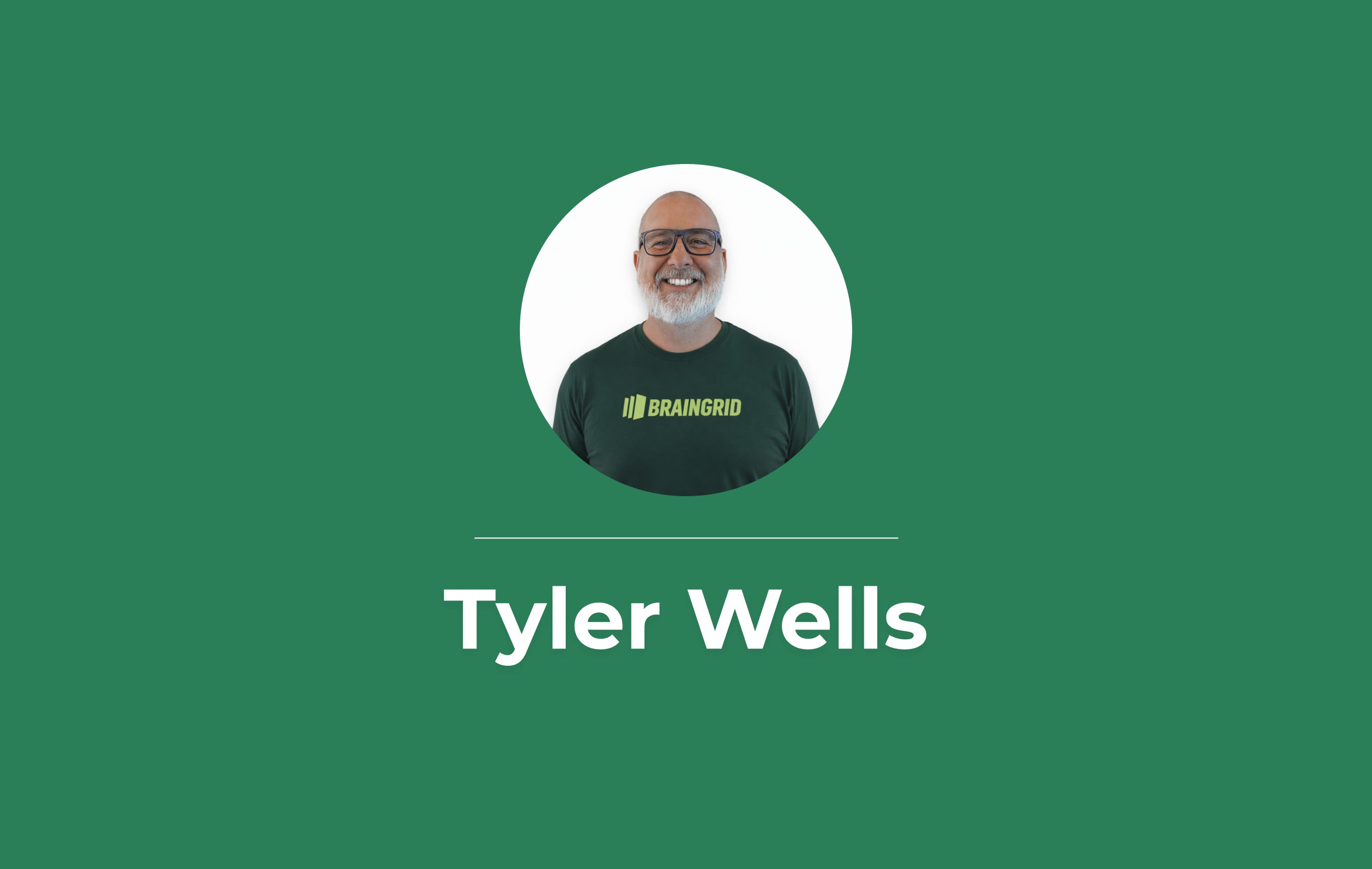
Tyler Wells is the Co-founder and CTO of BrainGrid AI, a planning-layer platform that acts as an AI product manager and tech lead before a coding agent writes a single line of code. Founded in 2025 alongside co-founder Nico Acosta, BrainGrid takes a plain-language idea and converts it into structured product specifications, task breakdowns, and implementation blueprints ready for tools like Cursor and Claude Code — targeting the domain experts, operators, and non-developers who have ideas they’ve never had the capital or technical background to build. The company emerged from the collapse of Wells’ prior startup, which he and Acosta wound down in late 2024 when they realized that the planning layer they were building for themselves was the product.
Previously, Wells spent seven and a half years at Twilio, ascending from individual contributor to Senior Director of Engineering before departing in 2021. At Twilio, he oversaw large engineering organizations and was responsible for cloud infrastructure operations — the environment where he first watched runaway AWS and Snowflake costs become six-figure surprises and developed the discipline around inference limits and cost management that now shapes BrainGrid’s architecture. Earlier in his career, he held engineering roles at Skype and Microsoft, accumulating more than 25 years of professional software engineering experience across the stack.
Wells is also the host of the Data Chaos Podcast and previously co-founded Propel Data, a prior analytics venture. He returned to individual-contributor engineering work when he co-founded BrainGrid — a deliberate choice to get back to building after years in senior management — and now operates a three-person team shipping product with parallel agent fleets across isolated Git worktrees.
Hey,
Thanks for reading this. I mean that. There's a lot of content out there competing for your attention, and you spent some of it here. I hope it was worth it. Even better, I hope it prompted you to think about something differently enough that you'd share it with someone who'd get something out of it too.
I started this podcast because tactics never stuck with me. What stuck were stories — business biographies, autobiographies, the decisions people made and why they made them. The principle only clicks once you know the story behind it.
So I built the thing I wanted to read. Every week I have two conversations with people who build in technology and product. Then I write the essay I wish I could find — one that puts you inside the conversation, through my eyes. What caught me off guard. What I kept thinking about after we hung up. Where the principle actually lives once you strip away the jargon.
I make this for myself first. If you read the way I do, you’ll want it too.
PS — If you want to pitch coming on the show, or you know someone I should talk to, shoot me an email at caden@hey.com with "January752" in the subject line so it gets past my filters. I'm not optimizing for famous guests. I'm optimizing for interesting conversations, even from people who aren't LinkedIn influencers.


