

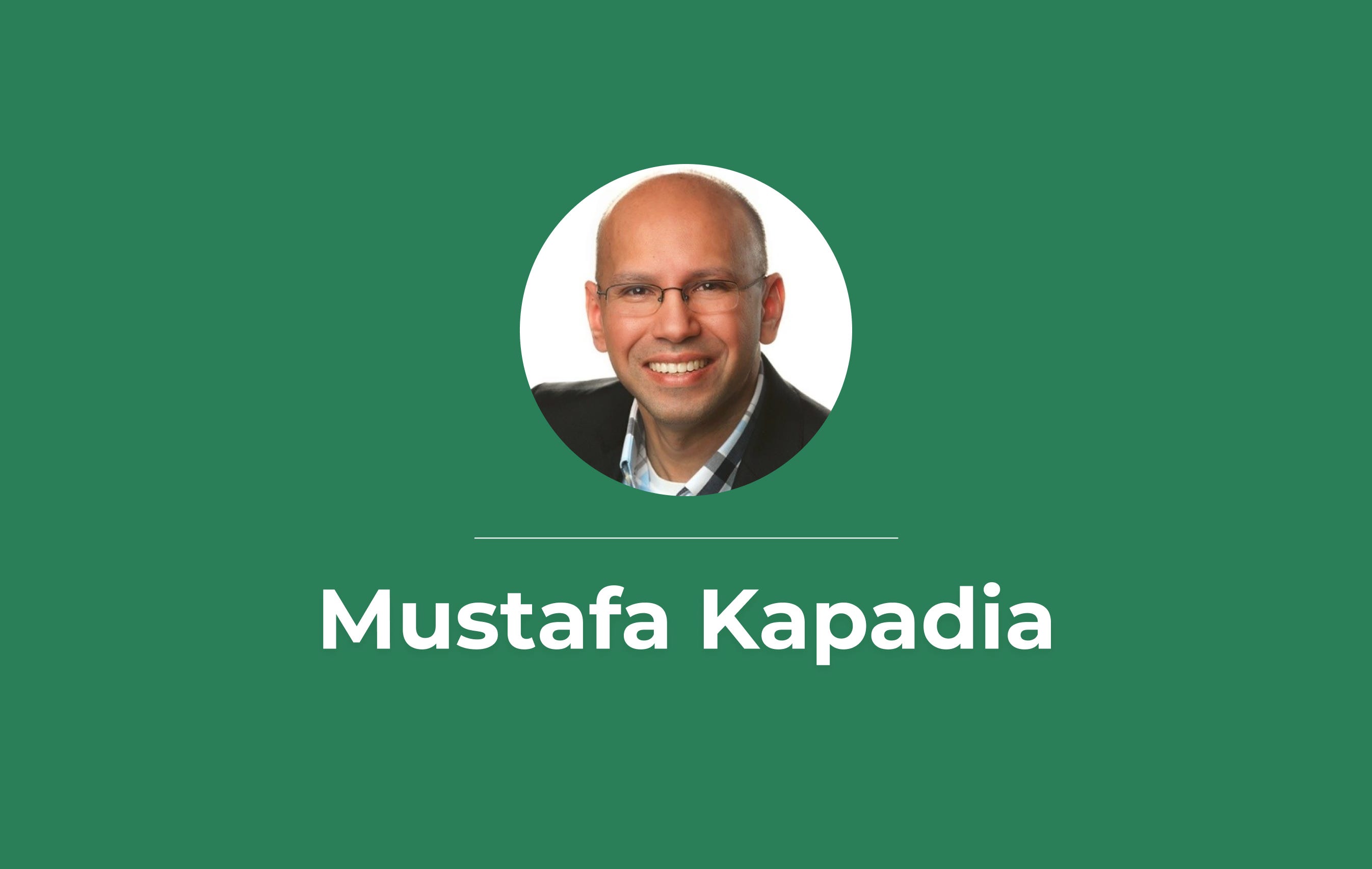
Mustafa Kapadia is the Managing Director at Echo Point, where he helps product organizations use AI to eliminate operational drag and compound product velocity. Rising to prominence in the 2010s at the intersection of digital transformation and DevOps, he became known for translating emerging technologies into operating models executives could actually run. Today he is widely regarded as a leading advisor to product leaders seeking to turn generative AI into durable leverage rather than surface-level experimentation.
Previously, as Global Head of Products & Innovation for Generative AI at Google, he led efforts to help the company’s largest enterprise customers, representing roughly the top 20% by scale, build new products and experiences on modern cloud and AI infrastructure. In that role from 2019 to 2023, he built new global innovation labs, combined sales and P&L ownership with hands-on product advisory, and drove adoption of generative AI across complex, multi-billion-dollar portfolios. He became known for helping Fortune 500 executives move from slideware to shipped product by redesigning how cross-functional teams discovered, validated, and launched new offerings.
His career highlights include a seven-year run at IBM, where he grew an internal DevOps capability 3x into a market-facing advisory practice and later led the North America Digital Transformation practice. From 2012 to 2014 he built a cloud automation service that delivered double-digit growth while helping large enterprises compress infrastructure delivery from months to days. Earlier, he served on the Board of Directors at the DevOps Institute from 2015 to 2019, shaping curriculum and thought leadership as DevOps moved from niche practice to mainstream mandate in organizations managing hundreds of applications and billions in IT spend. He also co-founded Science4Superheroes in 2014, running it for eight years to introduce scientific thinking to children under five through playful, family-centric programs.
As host of the Masters Of Product podcast and author of the AI Empowered PM newsletter on Substack, he helps more than 2,000 product managers each year learn to convert AI from a curiosity into a core part of their craft. Through private workshops, public cohorts, and consulting engagements, his work routinely unlocks multi-thousand-hour annual savings per organization and resets how product teams think about judgment, speed, and quality in the AI era.
Listen to episode 162 on Apple Podcasts↗ and Spotify↗
Building gets easier. Deciding what to build gets harder. Here’s how the top 1% are preparing.
“I had to figure out what I wanted to be when I grow up.”
Mustafa Kapadia says this quietly, almost to himself. He’s describing the moment two years ago when he left Google—after 20 years at places like IBM and Google, running accelerators, building consulting practices, watching digital transformations succeed and fail. And then he walked away to help product managers stop being terrified of the thing that might replace them.
I ask him about the fear. The senior engineers and PMs who’ve told me they’re just... opting out. Done. Can’t adapt. Won’t try.
“I think we have really two camps,” he says. He holds up two fingers, almost making the “peace sign”—then stops. “Well, three camps.”
Camp one: the AI-first believers. They start every task with an LLM. They use ChatGPT for one thing, Claude for another, Gemini for a third, NotebookLM for synthesis. They’ve rebuilt their entire workflow around what AI can do.
Camp three: the skeptics. They want AI at arm’s length. Afraid it’ll outsource their thinking. Afraid it’ll take their jobs. They’re the same people who resisted mobile phones, who pushed back against the internet, who had concerns about every new technology since the printing press.
And then there’s everyone else. The 60% in the middle of the bell curve, trying to figure out which way to go.
“They want to use AI,” he says of the middle camp. “But they don’t really know how. They’re doing surface-level stuff.”
Surface-level. He has a phrase for this. He calls it “using a Ferrari as a paperweight.”
Most PMs use AI for three or four tasks. Summarizing documents. Writing emails. Maybe a little brainstorming. They’ve been handed one of the most powerful tools ever created, and they’re using it to check boxes.
The top 1% do something different.
I’ve felt this myself—the gravitational pull of the easy path. Voice dictation made it so simple to just talk through everything with Claude. I found myself reaching for AI before I’d even tried to think. At some point I started looking for a “brick” for AI, the same way I use a physical lock to keep myself off my phone apps.
I tell him this. Maybe I should get my notebook out first, I say. Try to get as far as I can before—
He cuts me off. Not rudely. Precisely.
“You’re still using AI,” he says. “It’s just a matter of how you’re using AI. Depends on your comfort level.”
Some people think things through first, then use AI to refine their thinking. Others start with AI—”just give me all the options”—then choose the ones they care about, move forward with their own thinking, then use AI to refine it again. Their thought process is sandwiched between AI.
I ask him if there’s a right way.
“I don’t think there’s a right or wrong way,” he says. “I think the more important question is: does it help you become more creative, effective, innovative as a product manager? And if the answer is yes—then more power to you.”
He has a framework. Of course he does—he’s a consultant. But when he describes it, it sounds less like a sales pitch and more like a craft.
“Five keys,” he says. “Assign a role. Provide first-principle inputs. Give it instructions—best practices. Format. And then an example that ties it all together.”
The example he uses is user stories. You don’t just ask AI to write them. You prime the engine. You tell it: you’re world-class at this. You give it the problem, the user, the benefit, the feature. You tell it what a good user story looks like—customer-focused, unique, technical-free. You show it one.
“And then—” he pauses. “Even if AI gives you ten great user stories, you don’t take all ten.”
This is where it gets interesting.
“You take the one or two that resonate. You use your own PM thinking. Your own experience. Your own context.” He calls this human-AI optimization. You’re not outsourcing your thinking. You’re using AI to prime you—to surface options you might not have considered. And then you decide.
The middle 60% outsource their thinking. The skeptics avoid AI entirely. The top 1% sit in the tension between—augmented, not replaced.
The conversation turns to something stranger. Synthetic personas.
Mustafa is working with a client who has years of market research sitting on laptops and servers. Interviews. Surveys. Behavioral data. All of it gathering dust in slide decks nobody opens.
“How do you take that research and make it actionable?” he asks. “How do you give it to someone in sales, or marketing, or product?”
His answer: build a synthetic user. A simulated persona trained on all that research. Something a salesperson can practice objection-handling with. Something a PM can ask, “What would you think if we priced this at $99 instead of $149?”
“It doesn’t replace talking to a real user,” he clarifies. “But in those crazy questions you want to ask—it’s a great way to refine your thinking.”
Then he goes further.
“We have a client who’s building a synthetic competitor.”
I stop him. “A what?”
“A synthetic profile of their competitor. So they can think about second-order effects.” He’s more animated now. “If I drop my price, what is this competitor going to do? If I launch this feature—a feature they already have—how are the two comparing? What can they do to make my feature less valuable in the marketplace?”
None of this means it’s exactly what the competition will do. But it forces you to think. To make better decisions. You can run war games now that were never possible before.
I ask him about the skeptics. The 20% who won’t get on the bus. What happens to them?
He doesn’t sugarcoat it.
“The ship has sailed,” he says. “The train has left the station. Whatever analogy you want to use—it’s happening. The only question as a PM is: where do you want to be? In the driver’s seat? The passenger seat? Or in the caboose, being dragged?”
But then his tone shifts. Softer. Almost conspiratorial.
“If you’re a PM and you’re ambitious—and most PMs are, which is why I love them so much—this is the best time to differentiate yourself. Organizations are dying for PMs who can show an AI-first mindset. They just don’t know what that looks like.”
He’s not selling anymore. He’s confessing.
“I prefer not to talk about what good looks like. I prefer to show them. Because until you actually show someone what a good PM with AI can do—that’s when they say, ‘Okay. How fast can we move?’”
One client started with four or five AI use cases. After his team helped them understand what was possible—what the top 1% actually do—they identified over 250. That’s the gap. That’s the opportunity.
Near the end, he says something that surprises me.
“I think you’re going to need more PMs, not less.”
I must have looked skeptical.
“When you can build anything,” he explains, “deciding what to build becomes a much tougher decision. Building is going to get easier and easier. But figuring out what to build, what not to build, working with the business to determine what’s actually going to make an impact—that’s the job. And I think we’re going to need more people doing it.”
The order-taker PM—business decides, PM translates, engineering builds—that role is dying. What’s emerging is the PM as decision architect. The one who navigates the infinite possibilities that AI unlocks and says: this one. Build this.
He is not wrong. New computer science (CS) students are already doing this.
My engineering manager told me recently that his son is in college, doubling down on AI education instead of a traditional CS degree. The homework is mostly about giving context, setting up system prompts. “This is basically PM work,” I said.
Mustafa nodded when I told him this. It’s becoming a common observation. The engineers need product thinking. The designers need product thinking. Everyone’s developing the competency because the alternative—hiding behind tactical building, being a feature factory—doesn’t work anymore.
We sign off. He mentions a benchmarking study dropping soon—fifty or sixty CPOs, data on how the best are actually using AI. He gives me his Substack. Echo Point.
“I give away 95% of what I tell my clients for free,” he says.
I believe him. And I subscribe before the call ends.
The last thing I remember is him saying something about the middle 60%. How you don’t have to convert the skeptics. You just have to pull the middle toward the top. And once 80% of your organization is using AI for 250 use cases instead of four...
The other 20% stops mattering.


